
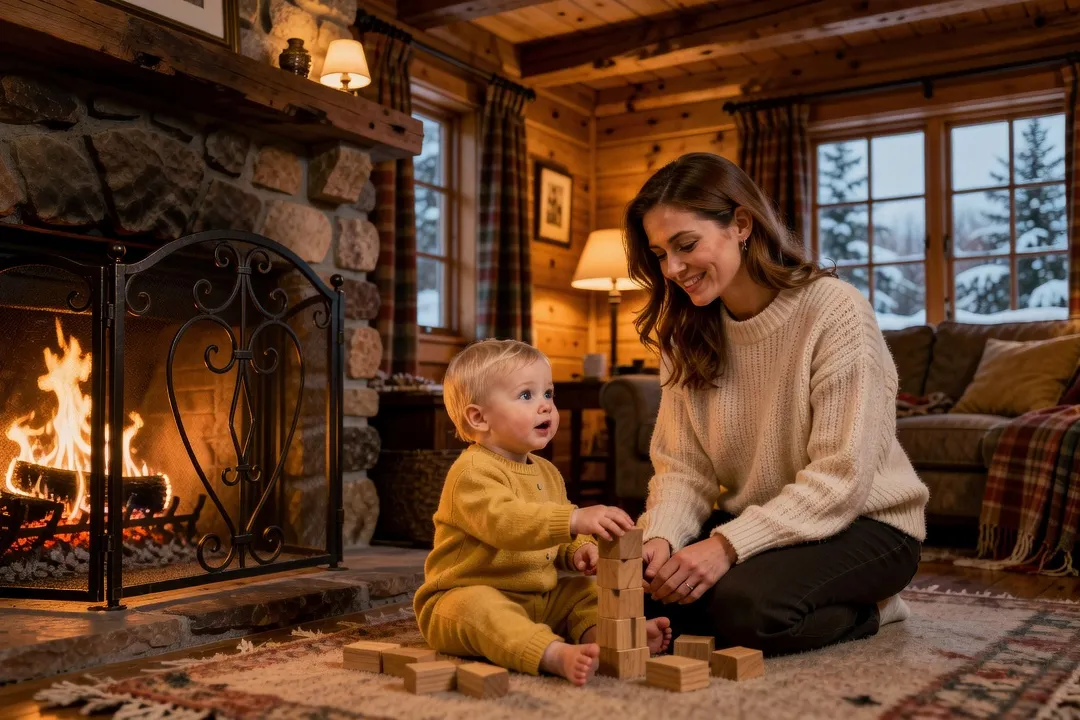
Traveling with a baby or young child to a chalet requires more than a travel crib and a few toys. Before booking, check four areas in particular: heat sources, stairs, access to water, and the storage of hazardous products. Ask the owner whether the property is fenced, whether the fireplace is protected, whether the stairs have safety gates, and how far away medical care is. A high-end rental can be very comfortable without automatically being suitable for toddlers: a precise checklist prevents unpleasant surprises upon arrival.
Asking the owner the right questions before booking
The safety of a family stay begins before you even choose the region. In the Laurentians, Charlevoix, Mauricie, or Gaspésie, chalets may be isolated, spread over several levels, built near a lake, or surrounded by wooded grounds. These features are part of the appeal of a Quebec getaway, but they require careful reading of the listing and a clear conversation with the owner or manager.
Do not simply ask whether the chalet is “child-friendly.” This expression may simply mean that a crib is available. Parents of a child who walks, climbs, or explores without understanding the consequences need to know the actual layout of the property.
Here are the most useful questions to ask before confirming the booking:
- Does the chalet have indoor or outdoor stairs? Ask whether they have sturdy railings and whether safety gates are already installed or compatible with portable gates.
- Is the wood-burning fireplace, stove, or gas fireplace protected by a fireguard? Also check whether fireplace accessories—poker, logs, matches, lighter—are out of reach.
- Is there direct access to a lake, river, pool, hot tub, or dock? A clear view from the chalet is no substitute for a physical barrier.
- Is the property fenced? At many chalets, the grounds are large, wooded, and not enclosed. This is pleasant for running around, but a child can quickly approach a road, slope, stream, or shoreline.
- Are household products and medications stored in a lockable cabinet or up high? This includes laundry pods, hot tub cleaners, fireplace products, and insecticides.
- Are outlet covers, smoke detectors, and carbon monoxide detectors present? Ask where the detectors are located and whether the chalet has a generator or supplemental heating system.
- Where are the bedrooms located? For a family with a baby, a bedroom near the main room may be convenient; for a more independent child, a bedroom in a loft or basement requires closer supervision.
- What is the cell coverage like on-site? In some rural areas, the network is unreliable. This matters just as much for emergencies as it does for using a connected monitor.
- Where are the most accessible emergency service, clinic, and hospital located? It is better to obtain this information before leaving rather than searching for it with a sick or injured child.
- Is the chalet maintained during the winter, and how is snow cleared? An icy driveway, snow-covered outdoor stairs, or a poorly cleared deck can quickly make moving around with a young child in your arms more difficult.
If you are traveling with several generations, the layout also matters. A sufficiently large chalet makes it possible to create quiet areas for naps while keeping play areas away from the stairs, fireplace, and kitchen. The guide on renting a chalet for a large family in Quebec can help you assess the room layout before booking.
Understanding risks specific to a chalet rather than a home
A chalet is not an urban home transported into the forest. It is often designed to take advantage of the landscape, the warmth of a fire, and access to water. For an adult, these features are assets. For a toddler, they create risks that may be absent or less common in daily life.
The wood-burning fireplace is the most obvious example. The glass on a stove, a fireplace door, or a metal surface can become very hot, sometimes even after the fire has gone out. A stable fireguard placed at a safe distance is essential. Do not let children play with logs, twigs, or fireplace tools: splinters, metal parts, and ashes also pose a hazard.
The unenclosed property deserves just as much attention. At home, parents know the boundaries of the yard and the neighborhood’s traffic patterns. At the chalet, the child discovers a new environment: a slope toward the lake, slippery rocks, an open shed, a firepit, a private road, an ATV trail, or an access road. The safest rule is to define an authorized play area as soon as you arrive, visible from the living areas.
Water presents a particular risk, even when it seems shallow. A beach, dock, river, hot tub, and pool do not require the same precautions, but they have one thing in common: supervision must be direct and continuous. The Lifesaving Society stresses the importance of constant supervision of young children near water. To prepare this aspect in detail, also read our interview on child safety near a pool or lake at a chalet.
Finally, many chalets have less visible technical installations: a secondary electrical panel, generator, propane tank, water treatment system, maintenance shed, or barbecue. These areas must remain outside play routes. Read the owner’s recommendations regarding electricity and backup appliances; our article on electrical safety at an isolated chalet and generator safety also provides useful guidance.
Checking the layout as soon as you arrive
Even after receiving satisfactory answers, carry out a family inspection before unpacking all the luggage. Fifteen to twenty minutes are often enough to identify what needs to be secured, moved, or declared off-limits during the stay.
Start by walking through the chalet at a child’s height. Kneel down if necessary: you will more easily notice an uncovered outlet, a dangling cable, an accessible woodpile, a small decorative object, or a cleaning product forgotten under the sink. High-end chalets sometimes feature carefully curated decor with fragile objects, candles, heavy books, fireplace accessories, or unstable furniture. The goal is not to turn the property into an empty space, but to limit temptations and falls.
Check the following as soon as you arrive:
- Do the stairs have a fixed, sturdy railing?
- Do doors leading outside, to the balcony, basement, or mechanical room close properly?
- Can the windows open widely at a low height?
- Are accessible electrical outlets covered?
- Are lamp cords, blind cords, chargers, and extension cords out of reach?
- Are knives, scissors, coffee pods, alcohol, medications, and household products stored up high or in a lockable cabinet?
- Are the fireplace, stove, barbecue, and outdoor firepit made inaccessible when not in use?
- Do rugs, stair runners, and wet floors create a slipping hazard?
- Do the smoke and carbon monoxide detectors appear to be present and working?
- Can doors leading to the hot tub, pool, or dock be easily opened by a child?
| Chalet area | What to check | Immediate action if necessary |
|---|---|---|
| Fireplace or stove | Hot surface, accessories, logs, ashes | Install a portable fireguard and prohibit access |
| Stairs | Gates, railings, slippery steps | Install a gate or keep the door closed |
| Kitchen | Products under the sink, knives, appliances | Move and lock away hazardous items |
| Bathroom | Medications, razors, hot water, bathtub | Store up high and never leave the child alone |
| Balcony and deck | Spacing between railings, door, slippery surface | Keep the door locked when not supervising |
| Dock and shoreline | Unrestricted access, life jackets, slope, rocks | Define an off-limits area and actively supervise |
| Bedroom | Bed, unstable furniture, blind cords | Set up a safe sleeping space and clear the floor |
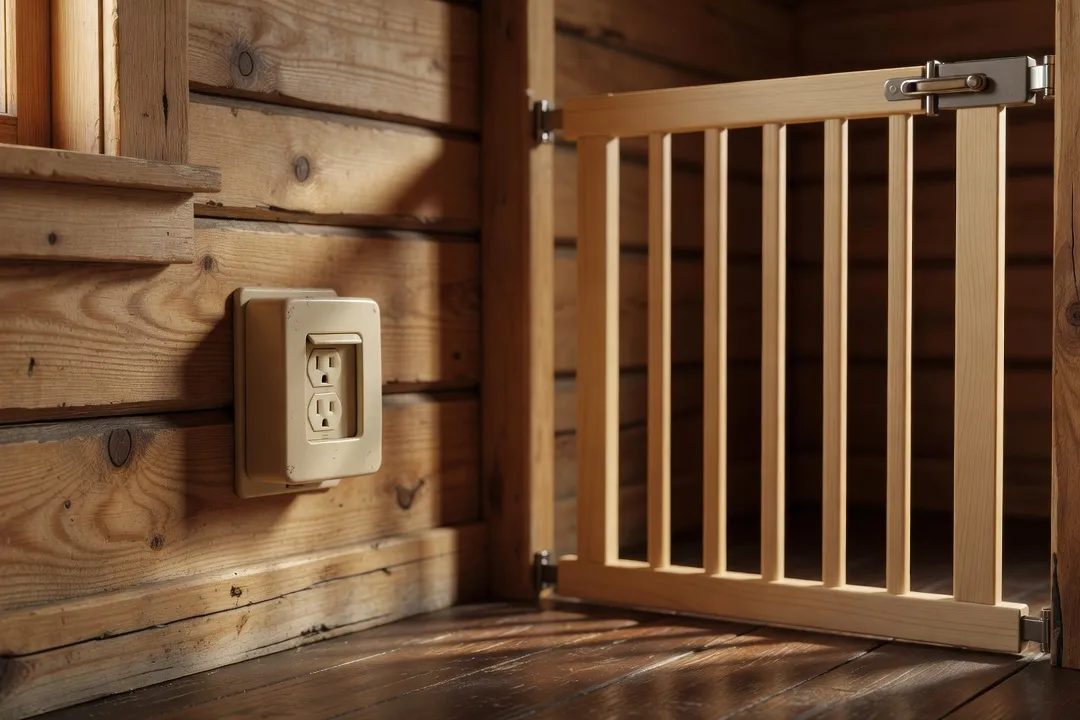
Do not assume that a gate provided on-site will be suitable for your child or the intended opening. Some gates are not suitable for the top of stairs, while others do not attach securely to a railing, log wall, or irregular frame. If you cannot secure access, choose a different arrangement: keep a door closed, move the play area, or sleep on the same level as the child.
Preparing the safety equipment to bring yourself
The best equipment is what you already know and can install correctly. A rental may provide certain items, but it is preferable not to depend exclusively on accessories whose condition, compatibility, or usage history you do not know.
A portable safety gate is particularly useful in multi-storey chalets, chalets with a loft, or those with direct access to a basement. Choose a model suited to the intended location: pressure-mounted gates may be practical for a doorway or the bottom of stairs, while a more stable installation is generally required at the top of stairs. Test it at home before leaving and bring the necessary parts.
The baby monitor deserves particular attention in rural areas. Solid wood walls, large floor plans, separate levels, and variable Wi-Fi coverage can reduce the reliability of some connected models. An audio or video monitor that uses a local signal may be a simpler solution, provided you check its range once on-site. Also keep in mind that no monitor replaces supervision of an awake child near a fireplace, pool, or body of water.
Here is a list of useful equipment for a stay with a toddler:
- Portable safety gate suited to the intended openings;
- Outlet covers, especially if the child tends to handle them;
- Soft night-light for unfamiliar hallways and nighttime awakenings;
- Baby monitor with chargers and backup battery;
- First-aid kit suited to your family;
- Thermometer, usual medications, and rehydration solutions recommended by your healthcare professional;
- Flashlight or battery-powered lantern;
- Approved, properly fitted life jacket for any trip in a watercraft;
- Non-slip bath mat if your child uses one;
- Small portable lock or safety device for certain cabinets;
- Non-slip footwear and clothing suited to temperature changes;
- Contact details for your emergency contacts, also written down on paper.
The Canadian Paediatric Society recommends, among other things, ensuring a safe sleep environment for babies: a firm, clear surface without unnecessary soft objects in the sleeping area. If you use a travel crib, check that it is complete, in good condition, and set up according to the manufacturer’s instructions. It may be tempting to improvise a sleeping arrangement on a sofa or large bed during the holidays, but being away from home does not make these arrangements safer.
For families also bringing a pet, plan a clear separation between the child’s play area, food bowls, and the dog’s space. The advice in our veterinary interview on chalet safety with a dog complements this arrangement well.
Securing the fireplace, electricity, and hazardous products
At the chalet, household risks do not disappear because the pace slows down. They often take a different form. A larger kitchen, a wood supply, an independent heating system, or a maintenance shed gives a curious child more opportunities to explore.
The fireplace should be subject to simple rules, repeated from the first day. Do not let a child touch the fireguard or go behind it, even when the fire appears to be out. Embers can remain hot for a long time. Store matches, lighters, and fire-starting products out of reach. If the fireplace is not essential to your comfort, the simplest decision with a highly mobile child may be not to use it.
Household products present another issue. In a primary residence, parents have often already adopted a storage routine. At a chalet, products may be under the sink, in the laundry room, near the hot tub, in a shed, or in a low cleaning cupboard. Detergent pods, concentrated cleaners, dishwasher products, and water treatment products should be considered particularly concerning. Health Canada recommends keeping chemicals and household products in their original containers, out of children’s reach, and never transferring them into food containers.
Electricity also requires a straightforward but careful inspection. Avoid overloading outlets with chargers, portable heaters, and kitchen appliances. Do not leave extension cords running across a walking area. If the chalet has a generator, do not touch it and make sure children cannot approach it. A generator must be used outdoors, away from openings, because of the risk of carbon monoxide. The recommendations of Health Canada and fire safety authorities remain relevant: a working carbon monoxide detector is essential when wood, gas, or propane is burned, or when appliances capable of producing this gas are used.
Supplemental heating requires increased vigilance. A portable heater should never be installed in a play area, near a child’s bed, blankets, curtains, or clothing. If the temperature is uncomfortable, contact the owner rather than adding improvised appliances.
Organizing safety around the lake, dock, and property
The presence of water is often a reason to book a chalet. However, it must be incorporated into your family plan from the first day, not only when you decide to put on swimsuits. A young child may be drawn to a dock, stream, puddle near the shore, or watercraft tied at the edge, even in cool weather.
Upon arrival, clearly explain the boundaries: where the child can play, which path leads to the lake, where the slippery rocks are, and which doors must remain closed. Use simple words and a consistent rule, for example: “The dock is only with an adult.” For young children, repetition is useful, but it is never enough to replace the close presence of an adult.
The Lifesaving Society recommends active supervision near water. In practice, this means that a designated adult does not read, cook, check their phone, or leave the area to get a towel. When several adults are present, name the person responsible rather than assuming someone is watching.
A few concrete measures reduce the unexpected:
- Keep life jackets visible and accessible, but do not consider a life jacket a substitute for supervision.
- Avoid ball games or running on a dock, balcony, or rocky shoreline.
- Remove floating toys left near the water: they may attract a child.
- Check the condition of the dock, boards, fastenings, and access to the watercraft.
- Keep doors leading to the shoreline closed when no one is going outside.
- Bring dry, warm clothing, even in summer, as water and wind can quickly chill a child.
- Never leave a child alone in a hot tub, even for a few moments; the temperature and depth require particular caution.
In winter, water remains present in another form. Frozen lakes, rivers, and ponds are not automatically safe play areas. Ice thickness and quality vary according to conditions, currents, snow, and temperature changes. Do not let children venture onto the ice without local confirmation and appropriate supervision. Shorelines may also be particularly slippery; suitable ice cleats for adults and boots with good traction make a real difference.
Establishing a realistic emergency plan for the whole family
A useful emergency plan fits on one page and can be understood by all the adults in the group. The goal is not to dramatize the holiday, but to know what to do quickly if a child is injured, develops a fever, swallows a product, or wanders away from the chalet.
As soon as you arrive, write down the full address of the chalet, including the street number, road, and municipality. Do not rely solely on a pin in a mapping app: in a stressful situation, a written address is easier to communicate. Also identify the access route for emergency services, especially if the chalet is located at the end of a private road, up a hill, or on a poorly lit road.
Prepare a plan containing the following:
- The exact address of the chalet and a clear landmark.
- The emergency number to call if needed, including 911 where this service is available.
- The Quebec Poison Control Centre: 1 800 463-5060, to be saved in phone contacts and written on a visible sheet.
- The name and location of the most accessible hospital or emergency department.
- The nearest clinic, pharmacy, or healthcare service point in your region.
- The location of the first-aid kit, fire extinguisher, detectors, and main exit.
- A division of roles among adults: who stays with the child, who calls, who guides emergency services, and who looks after the other children.
- An outdoor meeting point in case of evacuation.
The Quebec Poison Control Centre is a particularly important resource when a child has ingested or handled a potentially toxic product. Do not try to induce vomiting, and keep the product container at hand so you can provide precise information. In the event of breathing difficulties, loss of consciousness, a serious burn, drowning, or a severe injury, call emergency services immediately.
For a family on holiday, it is also useful to plan for common minor incidents: splinters, cuts, falls, bites or stings, fever, vomiting, or known allergic reactions. Bring prescribed medications in their original packaging without transferring them into unlabelled containers. Check the travel time to medical care before leaving, especially if you are traveling in a remote region or during a period of winter road conditions.
Adapting the checklist for winter stays
Quebec winters add particular risks, especially in chalets where heating, snow removal, and outdoor access are part of the experience. A child who has just left a heated home and a cleared sidewalk may underestimate how slippery a deck is, how deep a snowbank is, or how close the stairs are beneath the powder.
Before booking, ask how the chalet is heated: central heating, fireplace, wood stove, heat pump, electric baseboards, or supplemental heating. Also ask about the presence of smoke and carbon monoxide detectors, as well as the procedure in the event of a power outage. Outages can affect lighting, water, connectivity, and indoor temperature; a simple plan is therefore preferable to improvisation.
Upon arrival, inspect the outdoor stairs, deck, balcony, and path leading to the parking area. Identify areas where snow hides a step, edge, or change in level. If the chalet provides salt or abrasive material, keep it accessible to adults but out of children’s reach.
For young children, bring the following in particular:
- A snowsuit or warm layers suitable for outdoor play;
- Spare mittens, because wet hands get cold quickly;
- Boots with non-slip soles;
- A flashlight for returning after dark;
- A bag of dry clothes to leave near the entrance;
- A clear rule: no running on the deck, balcony, or steps;
- Constant supervision near high snowbanks, ditches, and snow-clearing areas.
Never place a supplemental heat source too close to a child’s bed or flammable objects. Keep blankets, clothing, and toys away from heating appliances. If the fireplace is used, arrange periods when the children play in another room or remain in a physically separate area.
FAQ
Is a high-end chalet automatically safe for a baby or young child?
No. Comfort, space, and the quality of the amenities do not guarantee the presence of gates, outlet covers, or lockable storage. You must check the chalet’s precise configuration and bring certain accessories suited to your child.
What are the three priority questions to ask before booking?
First ask how the fireplace and stairs are protected, whether access to the water is unrestricted, and whether the property is fenced. Also ask about the distance to medical care and the quality of cell coverage if the chalet is in a remote area.
Should I bring my own safety gate?
It is often a good idea, especially if your child is mobile and the chalet has several levels. However, make sure your model fits the opening and is suitable for where you intend to install it.
Does a life jacket allow a child to play alone near the dock?
No. A life jacket is important protection in a watercraft or near water, but it never replaces active adult supervision. Access to the dock and shoreline must remain supervised at all times.
What should be done if a child ingests a household product at the chalet?
Keep the product container, move the child away from the source, and quickly contact the Quebec Poison Control Centre at 1 800 463-5060 for instructions. If serious symptoms are present or there is an immediate emergency, call 911.