
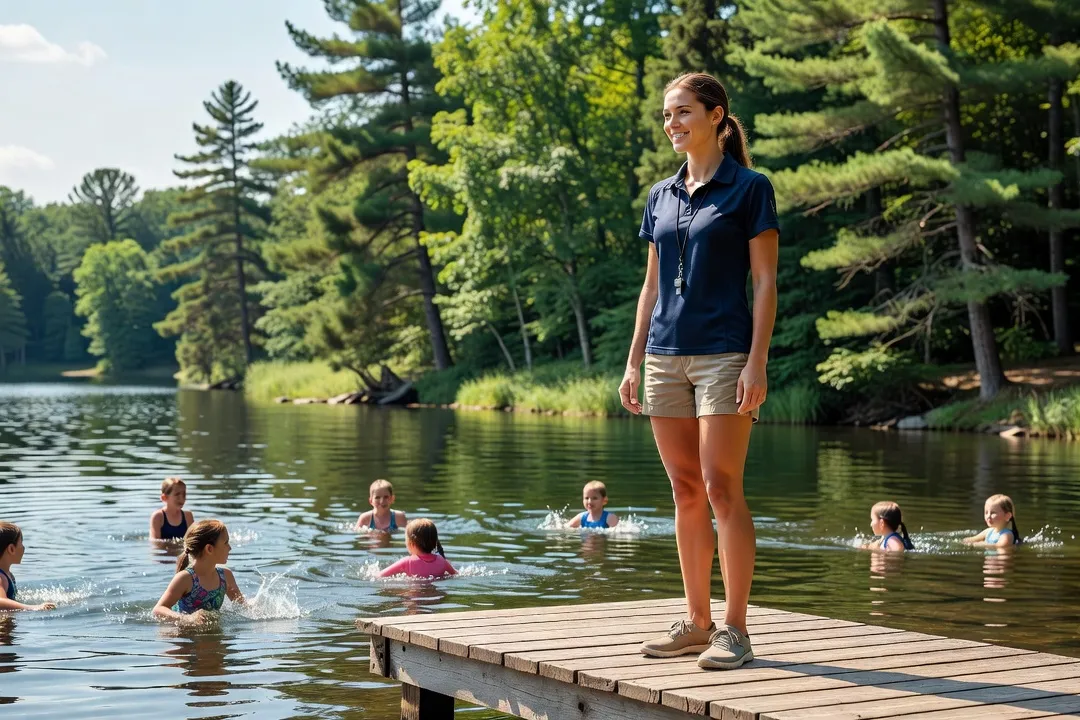
At a cottage, the best protection for a child near a pool or lake remains active supervision by a designated adult, with no phone or competing responsibility. Upon arrival, adults should also check access to the water, test safety devices, assign each child a properly fitted life jacket, and agree on simple rules before even unpacking. In this editorial interview, Camille speaks with Élise, a water safety instructor, about the appropriate precautions for vacation rentals.
What should be done during the first few minutes at the cottage?
**Camille:** A family arrives after several hours on the road, the children see the dock or pool and immediately want to go play. What should the adults’ priority be?
**Élise:** That impulse must be interrupted, even if the water appears calm and no one is planning to swim yet. In a rental setting, children are unfamiliar with the property, the doors leading outside, and where the depth changes. An adult should therefore conduct an inspection before the children are allowed to move freely around the cottage.I recommend starting by identifying all access points to the water: the patio door, the path behind the shed, the stairs leading to the dock, the pool fence, or the beach at the end of the property. Next, determine whether a toddler could open a door alone, move a chair up to a gate, or reach the lake after briefly escaping the adults’ notice. This inspection is a useful complement to a cottage safety checklist for toddlers.
Lastly, an adult must be officially responsible for supervision from the moment of arrival. Saying “we’re all watching” can easily create diffuse responsibility: everyone assumes someone else is watching. A phrase as simple as “I’ll watch the water until dinner, then I’ll hand over to you” avoids this ambiguity.
**Camille:** Is this check really necessary even if swimming is only planned for the next day?
**Élise:** Yes, because an incident can occur without any organized swimming activity. A child may want to retrieve a ball, watch ducks from the dock, or follow another child outside. Unloading luggage is a particularly distraction-prone time: doors are open, adults are busy, routines have changed, and the property is still unfamiliar.I recommend a brief family tour of the property. Physically show children the boundary they must not cross without an adult, identify the permitted entrance to the pool or lake, and then immediately put away any toys that could attract a child toward the water. This tour does not replace supervision, but it gives the rules a concrete point of reference.
Should vigilance differ between a private pool and a lake?
**Camille:** A fenced-in pool seems more predictable than a lake. Can supervision be relaxed a little there?
**Élise:** No. A pool is generally easier to define, but this sense of control can itself reduce vigilance. Clear water often makes it possible to see the bottom, the swimming area is confined, and the depth may be marked; nevertheless, a child can slip on the pool deck, enter through a gate that was not properly closed, or end up in the deep end without immediately attracting attention.At a lake, the danger is less uniform. The bottom may drop off suddenly, a rock may be slippery, aquatic plants may startle the child, and underwater visibility is often limited. Wind, waves produced by watercraft, currents near a channel or outlet, and water temperature—which may be significantly colder than the air—must also be taken into account.
The right question, therefore, is not “which place is safer?” but “what can’t I see or control here?” At a pool, pay particular attention to access points, changes in depth, drains, and behaviour on the deck. At a lake, also consider the condition of the bottom, distance from shore, drift, visibility, and weather changes.
| Element to observe | Private pool | Natural lake |
|---|---|---|
| Swimming boundary | Visible walls and deck | Area may not be marked |
| Depth | Often marked, but must be confirmed | Variable, with possible drop-offs |
| Visibility | Generally good if the water is maintained | Often reduced by sediment or vegetation |
| Water movement | Usually limited | Possible wind, currents, waves, and wakes |
| Children’s access | Door, fence, ladder, or gate | Path, beach, dock, or accessible shoreline |
| Ground hazards | Wet surface, steps, edge | Rocks, mud, branches, holes, and slope |
| Supervision reference point | Entire pool visible | Specific area to be defined from shore |
**Camille:** And what about a cottage on a very large body of water?
**Élise:** A large body of water should not be treated like a small, sheltered lake. On the St. Lawrence River, for example, tides, currents, waves, navigation, and water temperature can rapidly change conditions. Families considering a [cottage along the river in Bas-Saint-Laurent, Charlevoix, or Gaspésie](/en/blog/st-lawrence-river-chalets-regions-2026/) should check whether the shoreline is genuinely suitable for swimming rather than assuming it is based on photos.Even beside a calm lake in the Laurentians or Mauricie, a buoy does not guarantee that the entire lakebed before it is uniform. The adult should cautiously explore the area, with no children in the water, and choose a perimeter smaller than the maximum distance the child believes they can cover.
What safety equipment should be checked upon arrival?
**Camille:** What specific checks should parents carry out around a private pool?
**Élise:** Start by examining the enclosure, rather than merely checking whether a fence exists. Does the gate close and lock by itself? Does the latch actually work? Could furniture, a bin, or equipment placed against the fence be used to climb it? Does a door from the cottage open directly onto the pool area?The Government of Québec’s Residential Swimming Pool Safety Regulation sets out measures concerning enclosures and access control, among other things. In a rental, however, visitors are not expected to improvise a legal inspection or declare the installation compliant themselves. They must immediately report any defect they observe to the person in charge and prevent access if the protection appears insufficient.
A door or pool alarm can provide an additional layer of protection, but it does not replace either the enclosure or the adult. Upon arrival, check its power supply and ask how it works. An alarm that has been disabled because it is annoying protects no one.
The points to check before the first swim are as follows:
- closure and locking of the access gate or door;
- absence of objects that could be used to climb the enclosure;
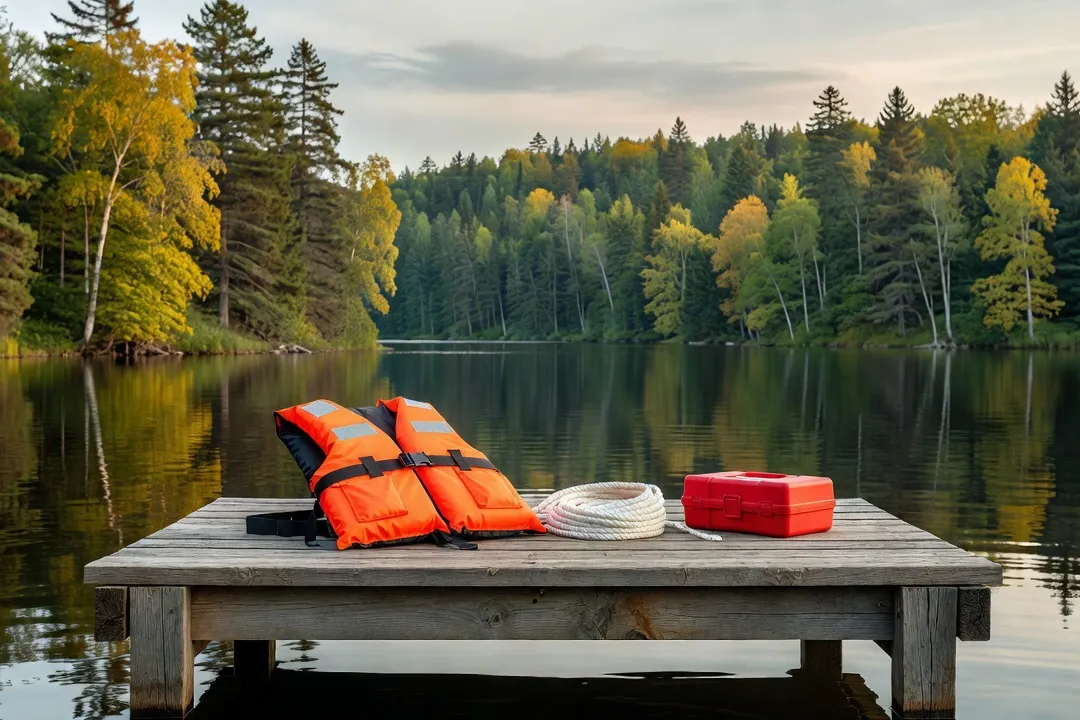
- presence of a pole, life buoy, or throw bag, depending on the installation;
- complete and readily accessible first-aid kit;
- charged phone and knowledge of the cottage’s exact address;
- working lighting along the route between the cottage and the water;
- stable pool or dock ladder;
- surface free of broken boards, protruding screws, or concealed obstacles;
- location of the pump, lighting, and alarm controls;
- procedure for contacting the manager in the event of a defect.
**Camille:** How can parents tell whether the available life jackets are actually suitable for their children?
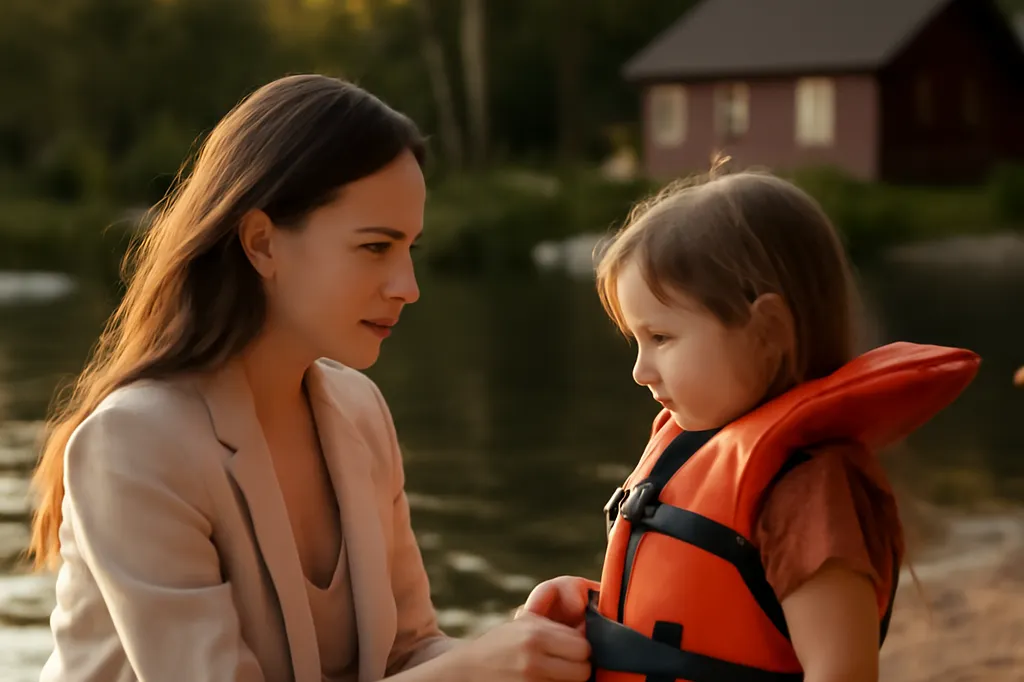
**Élise:** Read the label on each personal flotation device or life jacket and follow the manufacturer’s specified weight range. Also check for a recognized Canadian approval mark and inspect the condition of the straps, buckles, and buoyant material. Transport Canada notes that everyone aboard a watercraft must have an approved, appropriately sized personal flotation device or life jacket available.Once fastened, the life jacket should not rise up to the ears when gently lifted by the shoulders. For a small child, a crotch strap and head support may be important, depending on the model. An oversized life jacket can slip off; one that is too small may not provide the intended fit.
Water wings, inner tubes, and inflatable toys are not life jackets. They can deflate, come loose, or give children confidence beyond their abilities. If the cottage does not have the correct size, the prudent solution is to bring suitable equipment or postpone the activity.
What rules should be established with children before swimming?
**Camille:** What instructions are simple enough to remember during a vacation?
**Élise:** Rules should be brief, consistent, and tied to specific places. Telling a child to “be careful” does not provide an observable course of action. Saying “stop at the stone step and wait for an adult” is much clearer.I also recommend distinguishing permission to play outside from permission to go onto the dock. A child may be allowed to run on the lawn without being allowed to cross the boundary leading to the water. Older brothers and sisters can accompany a younger child, but they must not be given primary responsibility for supervising them.
A family can adopt the following rules upon arrival:
- No child goes onto the dock, beach, or pool deck without the designated adult.
- The life jacket is fastened before boarding a watercraft or playing on a dock, depending on age and ability.
- No pushing and no running on a wet surface.
- No diving into a lake or an area where the depth and obstacles have not been checked.
- No breath-holding or underwater swimming contests are allowed.
- A toy that falls into the water is retrieved by an adult.
- At the agreed signal, everyone gets out of the water without negotiation.
- Swimming stops if the supervising adult needs to answer the phone, prepare a meal, or go inside the cottage.
**Camille:** How should supervision be organized when several adults are present?
**Élise:** One person must be designated, followed by a clear verbal handover. The supervising adult should position themselves so they can see the entire area and remain close enough to intervene immediately, particularly with a young child or non-swimmer. The Lifesaving Society emphasizes active supervision and recommends staying especially close to young children rather than occasionally watching from the deck.Rotations can be short to preserve attention. The handover should be confirmed by both adults: “Are you taking over supervision? — Yes, I’m taking over.” Until that confirmation occurs, the first person remains responsible.
Alcohol, reading, headphones, phones, and preparing the barbecue are incompatible with this role. A more experienced swimmer is not a substitute either: the buddy system can complement adult supervision, never eliminate it.
How can you recognize a child in distress in the water?
**Camille:** In movies, a person in difficulty shouts and waves their arms. Is that realistic?
**Élise:** Not always. A child struggling to keep their mouth above water may be unable to shout because breathing becomes the priority. Their movements may be brief, uncoordinated, and almost silent. This is precisely why an adult must not rely on a call for help before reacting.Warning signs include a head very low in the water, the mouth at surface level, a vertical body with no effective forward movement, a fixed stare, closed eyes, hair covering the face, or arms pressing down on the water. A child may also try to move forward without going anywhere, cling to a ladder without managing to get out, or suddenly become silent after playing noisily.
Less dramatic distress must also be recognized. A tired child may still be able to speak but may become short of breath, swallow water, or no longer be able to return to shore. As soon as behaviour seems unusual, the adult must establish direct contact: call to the child, ask for a simple response, and intervene if the response is not immediate.
**Camille:** Does clear water make detection easier?
**Élise:** It can help, but it does not guarantee immediate detection. In a busy pool, reflections, floating toys, and other swimmers can conceal a child. The adult must regularly scan the entire area, including the steps, corners, and bottom.In a lake, reduced visibility further decreases the time available to locate a submerged child. The swimming area should therefore be limited, a vantage point with no blind spots should be chosen, and inflatable mattresses or watercraft should not be allowed to obstruct the view. A life jacket increases protection, but it does not turn a natural area into a controlled environment.
What first steps should be taken before emergency services arrive?
**Camille:** If a child appears to be in distress, what is the correct sequence of actions?
**Élise:** The first rule is not to create a second victim. From shore or the side of the pool, extend a pole, paddle, or sturdy object; if the child is farther away, throw a floating device attached to a rope, when one is available. Entering a lake to rescue someone can be dangerous without training, especially in the presence of currents, cold water, or an unstable bottom.Alert the other adults immediately and assign specific tasks: “Call 911,” “Bring the kit,” “Go guide emergency services at the entrance.” A general request such as “someone call” may not be carried out by anyone. At a remote cottage, the street address, access road, and a roadside landmark should already be written down near the phone.
Once the child is out of the water, check whether they respond and are breathing normally. If they are not breathing normally, call 911, follow the dispatcher’s instructions, and begin cardiopulmonary resuscitation according to your training; an automated external defibrillator should be used as soon as one is available. The Canadian Red Cross and the Lifesaving Society offer first-aid and CPR training that allows people to practise these actions rather than discover them during an emergency.
If the child is breathing, keep their airway clear, protect them from the cold, and monitor them continuously until care is transferred. A medical assessment remains necessary after a concerning immersion, particularly if there is persistent coughing, difficulty breathing, unusual drowsiness, confusion, or abnormal skin colour.
**Camille:** Are there any popular actions that should be avoided?
**Élise:** Yes. Do not suspend the child by the feet, press on their abdomen to “get the water out,” or delay ventilation and CPR while trying to drain their lungs. Abdominal thrusts should not be performed simply because the child swallowed water; they are reserved for a recognized airway obstruction.Do not conclude too quickly that everything is fine because the child talks or cries after being removed from the water. Keep the child resting, observe their breathing, and follow the advice of emergency services. In a real situation, 911 instructions and the actions learned in recognized training take precedence over a fact sheet read in haste.
How should you prepare for a remote cottage or a power outage around water?
**Camille:** Do cottages in rural areas present particular difficulties for emergency response?
**Élise:** Yes, because emergency services may need to find a private entrance, a secondary road, or a dock far from the parking area. Before swimming, adults should know the exact address, check cell coverage, and determine where to go to get a signal if necessary. It is helpful to keep a charged phone in a dry place without relying on the phone belonging to the person supervising.At night, access to the water must remain visible and the doors must be secured. A power outage can disable outdoor lighting, some alarms, or an automated mechanism. Families staying in a remote location can consult this interview on electricity, generators, and safety at a remote cottage to prepare independent lighting without running an extension cord near the water.
A headlamp, a charged flashlight, and backup lighting make it possible to check that all children have come inside. They do not, however, make nighttime swimming safe: perception of distances, the bottom, and movement becomes too poor, especially at a lake.
**Camille:** What should be done if equipment is defective in a rental?
**Élise:** Stop using the area concerned, photograph the defect without exposing the child to danger, and contact the person responsible for the cottage. A gate that does not close, an unstable dock, a broken ladder, or a non-functional alarm should not be offset by a simple promise to “watch more closely.” Temporarily block access in a safe manner and wait for an appropriate solution.Questions of liability, the owner’s instructions, and reporting a problem are discussed more broadly in the interview on regulations and insurance for cottage rentals. On site, the immediate decision remains simple: if essential protection is missing, the activity is postponed or moved elsewhere.
FAQ
Should a child who knows how to swim wear a life jacket at the lake?
Knowing how to swim in a pool does not necessarily prepare a child for cold, waves, currents, or an unseen bottom. An approved, properly fitted life jacket is particularly prudent on a dock, in a watercraft, and whenever conditions or the child’s abilities require it.
Can a pool alarm replace adult supervision?
No, because an alarm can be disabled, improperly adjusted, or heard too late. It provides supplementary protection alongside a functional enclosure, locked access, and active supervision.
How close should an adult stay to a toddler?
They should remain close enough to intervene immediately, generally within physical reach when a young child is in or beside the water. The distance should be reduced even further if the bottom is uneven, visibility is poor, or the child cannot swim independently.
Can you swim in the lake after sunset?
Nighttime swimming makes it more difficult to detect distress, assess distances, and locate a person under the water. With children, the most prudent rule is to close access to the dock or shoreline when the light no longer permits complete supervision.
What should you bring if the cottage provides no equipment for children?
Bring properly sized approved life jackets, a first-aid kit, a charged phone, lights, and the information needed to contact emergency services. Before the stay, confirm the features of the pool, dock, or shoreline so that you do not have to rely on equipment of unknown fit and condition.