
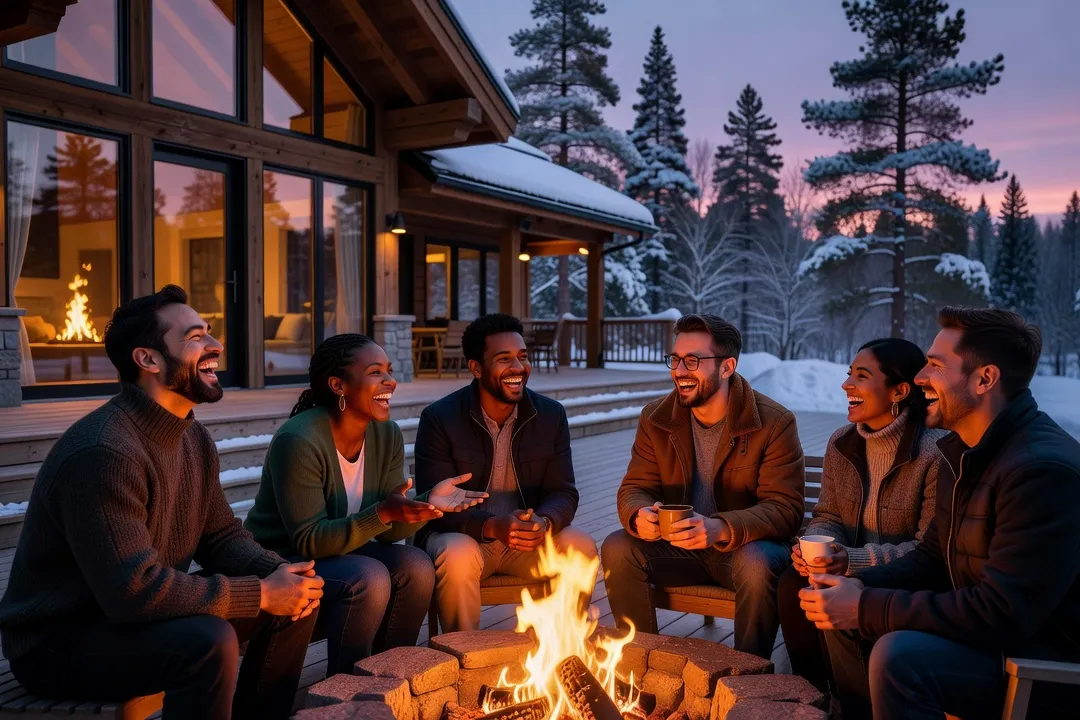
A chalet for a group of friends and a chalet for a family are not chosen according to the same priorities. With friends, people often look for a large common area, on-site activities, a hot tub, a pool table, and some flexibility for evenings. With family, comfort depends more on separate bedrooms, children’s safety, proximity to services, and peace and quiet. Before booking in Quebec, compare the chalet’s actual layout, occupancy rules, shared budget, and each adult’s responsibilities.
Define the Right Type of Stay Before Comparing Chalets
The first step is to distinguish the number of people from the type of group. Ten adult friends and two families of five may occupy a chalet with a similar capacity, but their day-to-day needs will be very different. The same living room, the same deck, or the same bedroom arrangement will not produce the same experience.
A group of friends generally wants to spend time together: cook as a team, play games, talk late into the evening, enjoy the hot tub after a hike, or extend a meal without having to split up too early. The ideal layout therefore emphasizes conviviality, with a spacious kitchen, a long table, a living room that can genuinely accommodate all occupants and, ideally, a second relaxation area.
A family, especially when travelling with young children, instead needs to preserve rest periods. A baby who goes to sleep early, a child who takes a nap, or a teenager who wants their own space immediately changes how the chalet is used. In this context, enclosed bedrooms, accessible bathrooms, and separate play areas often become more valuable than one enormous open room.
Before looking at the photos, ask yourself a few simple questions:
- Who will sleep with whom, and who needs an enclosed bedroom?
- Will there be young children, teenagers, pets, or people with reduced mobility?
- Is the stay focused on group activities or rest?
- Will the evenings be lively or rather quiet?
- Is everyone arriving and leaving at the same time?
- Is the group willing to share beds, sofa beds, or bathrooms?
For a multigenerational stay, our guide to renting a chalet for a large family in Quebec usefully complements this reflection. It is particularly relevant when grandparents, parents, and children need to live together under the same roof.
Common Areas or Private Bedrooms: The Comparison That Changes Everything
A chalet’s listed capacity does not tell the whole story. It indicates the maximum number of permitted occupants, but does not necessarily specify the level of privacy, circulation between rooms, or the comfort of a group whose schedules differ.
For friends, an open-plan area is often an asset. A large kitchen island, a dining room that avoids eating in shifts, a living room with enough seating, and a games area foster the feeling of going away together rather than simply sleeping in the same place. If the chalet has a finished basement, a games room, or a second living room, this also allows some people to talk while others watch a movie or play cards.
For a family, an open-plan area is still pleasant, but it should not be the only criterion. Children may be woken by conversations, the television, or dishes when the kitchen and living room are adjacent to the bedrooms. A house with clearly separated areas is often more restful: bedrooms away from the social area, a floor reserved for sleeping, a door that isolates a games room, or a secondary living room.
Here is a practical comparison to guide your selection.
| Criterion | Chalet for a group of friends | Chalet for a family |
|---|---|---|
| Central room | Very large common area for cooking, eating, and staying up late | Comfortable common area, but with the option to retreat |
| Bedrooms | Sharing may be acceptable to many groups | Enclosed bedrooms and an arrangement suited to parents and children |
| Bathroom | Having several is useful for speeding up departures | Important for baths, routines, and staggered wake-up times |
| Recreation area | Pool table, games, bar, fireplace, deck, hot tub | Games room, reading nook, secure area, and separate television |
| Location | Proximity to restaurants, trails, skiing, or evening activities | Quiet, easy access, proximity to daytime activities and services |
| Pace of the stay | Flexible, often later | Structured around meals, naps, and bedtimes |
Do not underestimate the quality of the sleeping arrangements either. A sofa bed can help out a group of friends for two nights, but it can become a source of frustration if a family is counting on it to accommodate a parent with a child. Check the bed descriptions, bedroom dimensions, and whether bunk beds are available before confirming the booking.

Choose the Location Based on the Group’s Pace
Quebec offers a wide variety of settings, from the Laurentians to the Eastern Townships, from Charlevoix to Mauricie, not to mention Outaouais and Gaspésie. Yet the same region does not automatically suit every group in the same way.
With friends, proximity to activities can weigh heavily in the decision. A group planning skiing, hiking, cycling, a culinary outing, or water activities will appreciate a chalet that reduces travel time. This does not mean you need to seek constant activity: many travellers want a private forest or waterfront setting while retaining access to activities within a reasonable radius.
For a family, tranquillity and logistical simplicity often take precedence. A difficult access road, an unsecured dock, a steep slope, or a property far from services can complicate a stay with young children. Families benefit from looking for an environment where walks, outdoor games, and daytime activities are accessible without turning every outing into an expedition.
The location criteria to prioritize are therefore not the same:
-
For friends:
- access to the planned trails, slopes, lakes, or attractions;
- outdoor space that allows everyone to gather without disturbing the neighbourhood;
- a realistic distance for late arrivals and Sunday departures;
- the ability to pick up a few groceries or order a meal without travelling a long distance.
-
For a family:
- an easy road and parking, even with a lot of luggage;
- grounds open enough to supervise the children;
- proximity to activities suited to different ages;
- limited exposure to immediate hazards: a steep shoreline, an unprotected staircase, an accessible fireplace, or fast-moving traffic.
The safety of very young children deserves careful consideration, especially when a chalet has a hot tub, water access, an indoor staircase, or a fireplace. Consult our chalet safety checklist for toddlers to prepare for your stay with greater peace of mind.
The Canadian Paediatric Society’s recommendations also stress the importance of active supervision around water, including near hot tubs and bodies of water. A barrier, a door, or a verbal rule can never replace a designated adult when young children are playing near water access.
Priority Amenities Are Not the Same
Amenities often create the wow factor when booking, but they need to be considered according to the group’s actual use. A hot tub does not make up for a kitchen that is too small for twelve people, and a games room is not enough if the bedrooms are poorly suited to a family with two babies.
For a group of friends, social amenities generally offer the most value. They give the stay a natural structure and prevent everyone from staying on their phone or retreating to their bedroom. A pool table, foosball table, sound system used at a reasonable volume, outdoor firepit, covered deck, or hot tub are particularly appreciated. The kitchen also matters enormously: enough dishes, a large preparation surface, a functional refrigerator, and a suitable barbecue make shared meals easier.
For a family, amenities should reduce the adults’ mental load. The following items are worth checking before booking:
- a crib, playpen, or high chair, when provided and suitable for your needs;
- a stair gate or the ability to secure high-risk areas;
- a practical bathtub or shower for young children;
- a washer and dryer for longer stays;
- sturdy dishes and a suitable dining area;
- bedrooms where a travel crib can be set up without blocking circulation;
- a separate television or games room for rainy days;
- outdoor space that can be used without constant supervision from a distance.
The Canadian Paediatric Society recommends that infants sleep on their backs, on a firm, clear surface, in an appropriate sleep environment. If you are travelling with a baby, do not assume that a bed provided on-site automatically meets your routine or criteria: bring your own safe sleeping solution if necessary and check the owner’s instructions.
For a small group mainly seeking privacy and rest, the logic is different again. A stay for two requires fewer bedrooms and more atmosphere, as explained on our page about a romantic weekend in a cosy chalet. This clearly shows that there is no single definition of an “ideal” chalet: everything depends on the relationship between the occupants and their expectations.
Split Costs and Manage the Booking Without Creating Awkwardness
Group bookings work best when the financial rules are clear before the deposit is paid. Among friends, the most common issue is not necessarily the total amount: it is the feeling that one person is paying more for a less comfortable bedroom, staying for less time, or bearing unexpected costs alone.
A fair method is to separate expenses into two categories: shared costs and differences in comfort. The cost of the chalet, cleaning fees, firewood if applicable, and essential purchases can be divided equally among adults. The group can then adjust each contribution according to the bedroom: private suite, en suite bathroom, double bed reserved for a couple, or a particular view.
For families, the calculations are often simpler when costs are divided by household rather than by individual. A family of four does not always consume exactly twice as much as a couple, but it uses more space, linens, dishes, and bathroom time. The most important thing is to choose a formula everyone accepts before booking, not to aim for impossible precision after the fact.
Here is a practical management approach:
- Designate one person to handle the official booking.
- Share the chalet’s full description, bedroom photos, and rules before collecting money.
- Set an internal payment date earlier than the owner’s deadline.
- Decide in advance how individual cancellations will be handled.
- Set aside a small shared reserve for groceries, firewood, bags of ice, or unexpected expenses.
- Keep important communications in a group conversation accessible to everyone.
The person who books should not automatically become the bank, concierge, and referee for the stay. Another member can take care of groceries, another of meals, and another of checking the chalet’s condition upon departure. This distribution reduces tension, especially in groups of friends where no one wants to feel like they are “working” while everyone else relaxes.
Establish Good-Neighbour Rules Among Friends
A high-end chalet offers space and privacy, but it does not give you free rein to hold a noisy party. Municipalities, resort neighbourhoods, and owners may enforce rules regarding noise, parking, outdoor fires, pets, and the number of occupants. These rules exist to preserve neighbours’ quality of life, site safety, and the long-term viability of short-term rentals.
Being a good neighbour starts before arrival. In a group of friends, it sometimes takes only two or three very enthusiastic people to turn a convivial stay into an evening that disturbs the entire area. Designate someone who knows the chalet’s rules and can intervene tactfully if the volume rises, cars are parked in the wrong place, or the hot tub becomes noisy late in the evening.
In particular, adopt the following habits:
- strictly observe the quiet hours specified by the owner;
- keep music indoors and avoid speakers on the deck late at night;
- limit noisy movement between the hot tub, firepit, and parking area;
- use only authorized parking spaces;
- never exceed the declared number of occupants;
- check local rules before lighting an outdoor fire;
- store garbage to avoid attracting wildlife.
In Quebec, the Régie du bâtiment du Québec provides information on requirements concerning, among other things, building safety and certain building equipment. Municipal rules, meanwhile, may vary from one area to another. It is therefore essential to read the regulations provided by the chalet manager rather than relying on what was permitted at a previous rental.
Fire safety instructions are also important. The Société de l’assurance automobile du Québec and municipal fire departments regularly remind people that impaired driving remains dangerous: arrange designated drivers, sufficient sleeping accommodations, and no pressure to get back on the road after an evening of drinking. The luxury of a chalet also lies in being able to stay on-site safely.
Insurance, Liability, and the Actual Number of Occupants
Responsibility for a stay does not disappear because the costs are shared. The person whose name appears on the rental agreement is usually the owner’s or manager’s main point of contact. They may be held accountable for damage, failure to follow the rules, exceeding occupancy limits, or an incident caused by a member of the group.
This is why it is essential to declare the exact number of occupants, including children when the agreement requires it. Adding people without authorization can create safety issues, invalidate certain rental terms, and lead to fees or termination of the stay. Occupancy limits are not merely administrative: they are linked to sanitary facilities, exits, parking, wastewater treatment, and the building’s capacity.
For families, responsibility also involves supervision. Parents and accompanying adults must check the rules associated with the hot tub, dock, watercraft, fireplace, stairs, and outdoor games. For groups of friends, it often extends to alcohol consumption, driving, noise, and the condition of the premises upon departure.
Personal home insurance may sometimes include liability coverage, but whether it applies depends on the policy, the situation, and the insurer. Never assume that it automatically covers all damage in a chalet rented on a short-term basis. Contact your insurer if you have specific questions, particularly if you are transporting expensive equipment, travelling with a pet, or planning to use a watercraft.
The Autorité des marchés financiers (AMF) explains the importance of properly understanding insurance coverage and applicable exclusions. For its part, the Insurance Bureau of Canada offers useful general resources for better understanding the principles of home insurance and liability. To explore rental-specific issues in greater depth, consult our guide to regulations, insurance, and maintenance for a short-term chalet rental.
Before leaving, conduct a group check: photos of any pre-existing damage where applicable, confirmation of the number of occupants, outdoor furniture put away, garbage sorted according to the instructions, dishes cleaned, and doors locked. These simple actions protect both the security deposit and the relationship of trust with the owner.
FAQ
How do you choose between a chalet with an open-plan area and a chalet with several enclosed rooms?
For friends, a large open-plan area makes shared meals, games, and evenings easier. For a family, prioritize a layout that allows children to sleep away from noise and adults to retreat when necessary.
Is it fair to charge all friends the same price?
Yes, if everyone agrees to an equal split and the sleeping arrangements are comparable. If some bedrooms offer much more privacy or a private bathroom, an adjustment by bedroom is often more comfortable for the group.
Which amenities are most useful for a family stay?
Separate bedrooms, a washer and dryer, a play area, a functional kitchen, and child-appropriate safety features are often more useful than entertainment equipment. Also check for an appropriate sleep environment if you are travelling with a baby.
Can visitors be invited to the chalet without declaring them?
You must first consult the agreement and obtain permission from the owner or manager. Even visitors who do not stay overnight may violate capacity, parking, noise, or insurance rules.
Who is responsible if a member of the group damages the chalet?
Responsibility depends on the rental agreement and the circumstances, but the person who books generally remains the main point of contact. It is best to agree before the stay that anyone responsible for damage will report it immediately and contribute to the applicable costs.