
Reading time: 12 minutes
Did you know that only 30% of winter visitors to Quebec cottages do downhill skiing? The remaining 70% — families with young children, seniors, non-skiers, people on a tight budget, or simply those curious about something else — have access to an exceptional range of winter activities that traditional tourism promotion neglects in favour of ski resorts. To plan your stay, combine these activities with a fishing cottage rental in Quebec for a complete winter experience.
Why Quebecers love winter at the cottage even without skiing
The Quebec winter has a worldwide reputation for harshness — and that reputation is deserved. But over the generations, Quebecers have developed a unique winter outdoor culture that turns this harshness into a resource.
The philosophy is simple: there is no bad weather, only bad clothing. And once you are properly equipped, the Quebec winter reveals incomparable qualities: the air is crystal clear, the forests are silent under the snow, frozen lakes are endless playgrounds, and the thermal contrasts (sharp cold outside, intense heat from the sauna or fireplace) create sensations found nowhere else in the world.
For families with children, a winter without skiing is often the ideal format: snowshoeing, fat biking and ice fishing suit all ages from 5-6 years old, without the learning curve (and the falls) of downhill skiing.
Snowshoeing: the perfect winter activity for all levels
Snowshoeing is a very popular activity in Quebec. More accessible than cross-country skiing, less technical than snowmobiling, it turns any forest trail into a winter adventure.
Who it's for: from 4-5 years old (with suitable children's snowshoes) up to seniors. No experience required — 10 minutes of adjustment is enough to walk normally in snowshoes.
Equipment: Modern aluminum and nylon snowshoes are light (600 to 900 g per pair) and manoeuvrable. Rental is generally available at outdoor centres for $15-25/day. Telescopic poles improve balance — recommended for seniors and hilly terrain.
The best snowshoeing areas in Quebec:
- Gatineau Park (Outaouais): 200 km of year-round trails, spectacular hilly landscapes, varied levels
- Mont-Tremblant National Park: networks of marked trails with panoramic views
- La Mauricie National Park: an incomparable sense of wilderness, frozen lakes as far as the eye can see
- Massif de Charlevoix: for experienced hikers, 2-3 day snowshoe circuits with a night in a refuge
Practical tips: Start with 5-10 km circuits on flat terrain. Snowshoeing in fresh snow burns 40% more calories than standard walking — stay hydrated and bring energy snacks.
Snowmobiling in Quebec: trails, rules and beginner tips
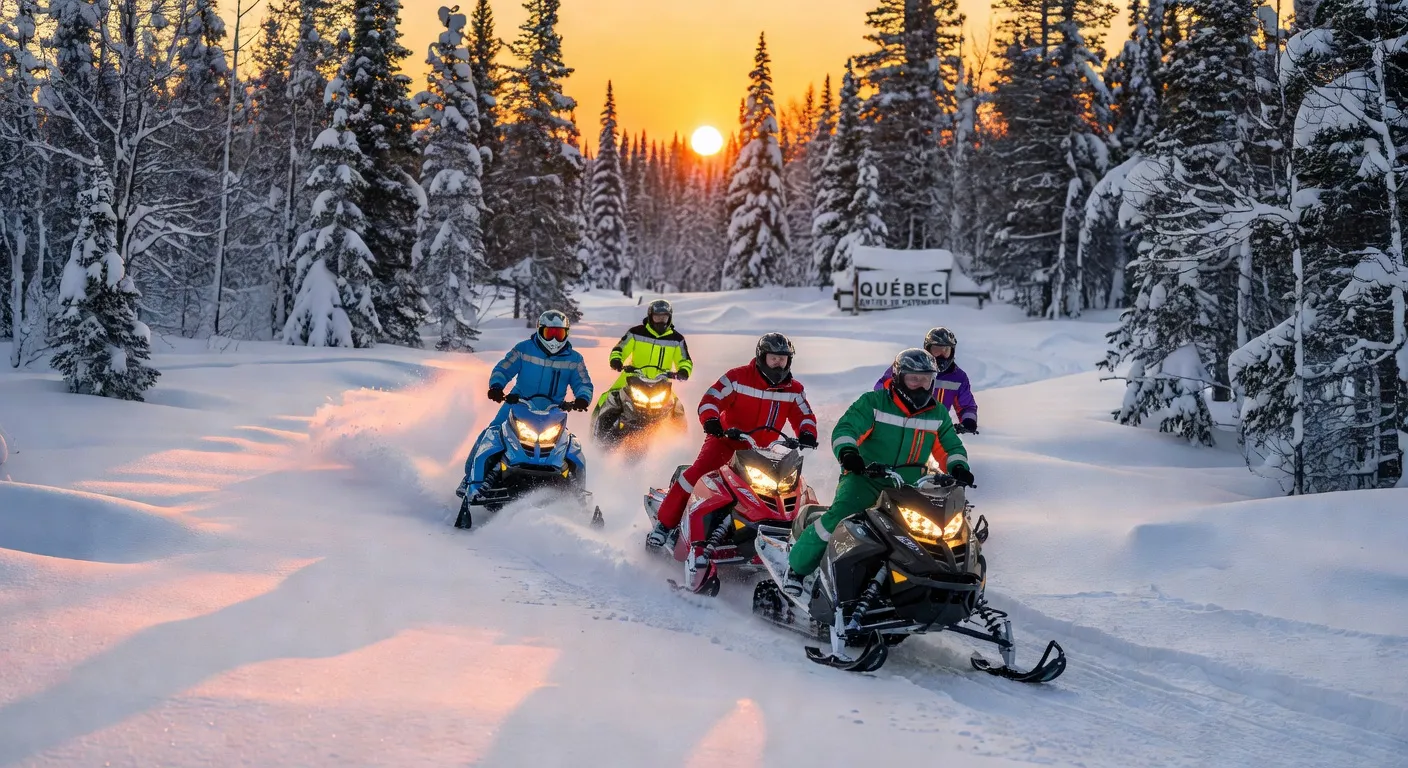
Quebec has the most extensive snowmobile network in the world: 33,000 km of marked trails, including 10,000 km of Trans-Québec trails linking most regions. For cottages, the main appeal is having direct access to this network from your accommodation.
Rules to know in 2026:
- Minimum age of 16; drivers aged 16 and 17 must hold a valid driver's licence and a training certificate
- Snowmobile registration is mandatory (usually included in the rental)
- Right-of-way fee in effect: a seasonal pass (about $250-300/season) or a daily pass (about $25-35/day) is required to use the trails of the Fédération des clubs de motoneigistes du Québec
- Helmet required at all times
- Maximum speed: 70 km/h on trails (varies by zone)
For beginners: A guided rental is the best option. Guides introduce you to the basic techniques (brake, throttle, turning, body position uphill and downhill) and help you avoid common mistakes. Expect generally $300 to $500 per person for a one-day guided excursion, equipment included.
Popular circuits from cottages: The vast network of snowmobile trails in the Laurentians (about 2,500 km according to the Fédération des clubs de motoneigistes du Québec) and the local circuits of the Gatineau Valley offer a remarkable variety of landscapes.
Fat biking on snow: the 2026 winter trend around cottages
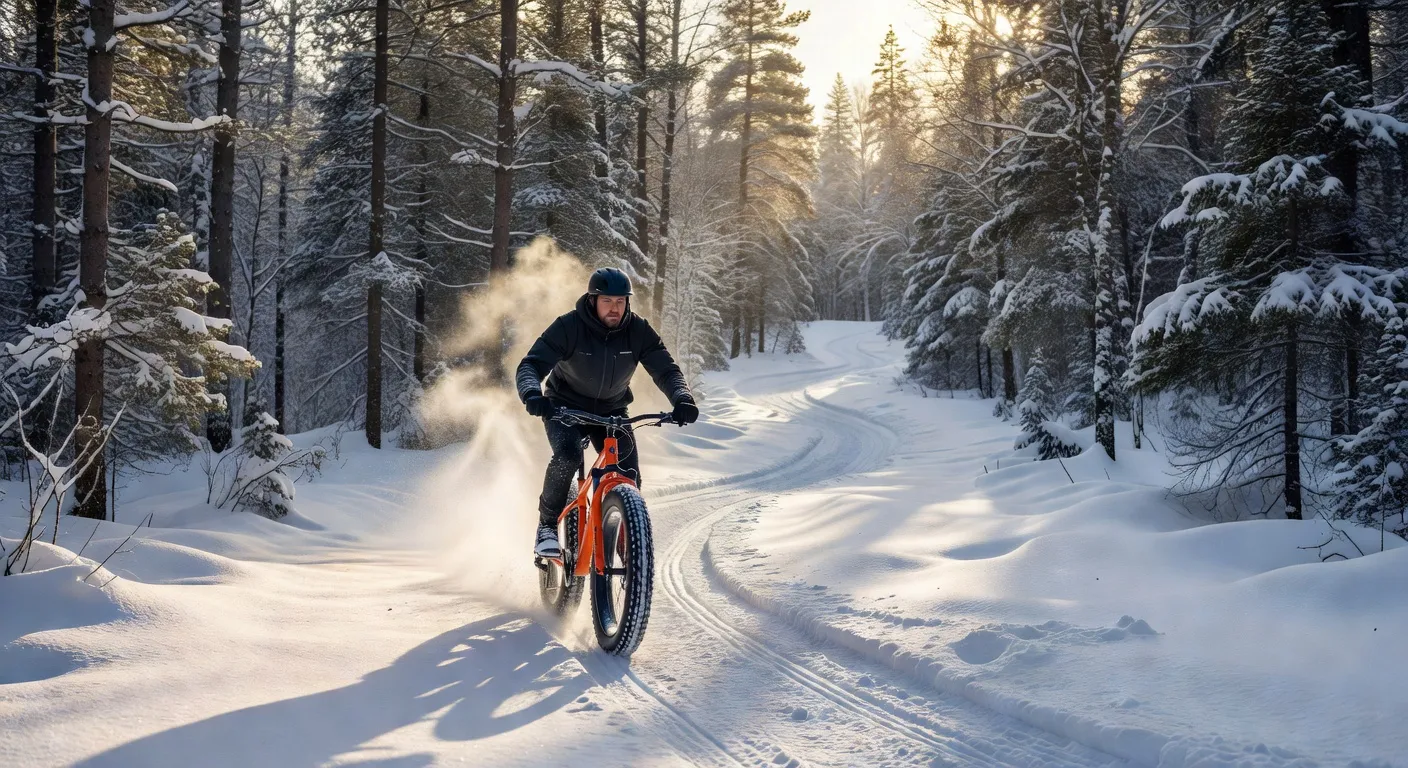
The fat bike — a bicycle with oversized tires (4 to 5 inches wide) — has become, in just a few years, the most dynamic winter trend in Quebec. Its wide tires let it float on packed snow, turning snowy forest trails into a cycling playground.
Why fat biking is booming in 2026:
- Accessible from the very first try (natural stability of wide tires)
- Intense and effective physical workout — 1 hour of fat biking burns 600-900 calories
- Quiet and non-polluting — allowed in all parks and nature reserves
- Photogenic — images of fat biking in a snowy forest are among the most shared on Quebec social media
- Active community — organized "fat bike" events in the Laurentians, Eastern Townships and Charlevoix
Where to fat bike from a cottage: The Parc linéaire Le P'tit Train du Nord (232 km), the Corridor-Appalachien network in the Eastern Townships, and the Mont-Sainte-Anne trails offer the best conditions. In the Outaouais, Gatineau Park allows fat biking on certain designated trails in winter.
Equipment rental: $40-65/day at most outdoor centres in tourist regions. Booking recommended in high season (January–February).
Ice fishing from a cottage: gear, lakes and target species
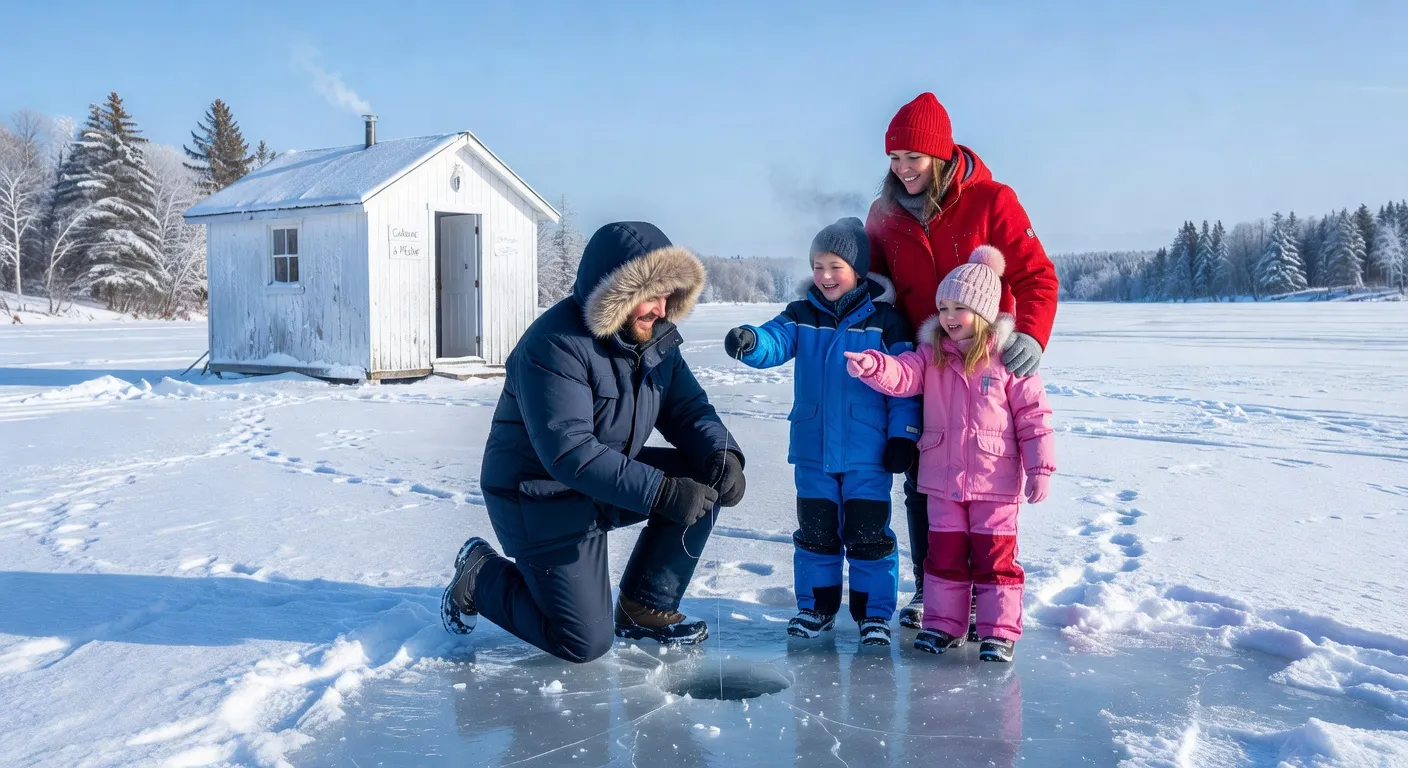
Ice fishing is a deeply rooted Quebec tradition, and one of the most accessible activities from a winter cottage. For expert advice on lake fishing, our interview with a Quebec fishing guide offers the best techniques for each species and each season.
Season and conditions: Ice fishing in Quebec generally begins in January (when the ice reaches a minimum thickness of 15 cm) and ends in mid-March. The very cold nights of January-February produce the thickest ice and the most productive fishing.
Basic equipment:
- Auger (manual or electric) to drill through the ice — rental available at outfitters
- Light fishing lines (4-8 lb) with jigging lures or live bait
- Ice thermometer to check thickness (absolute safety)
- Portable shelter or ice fishing hut (some cottages provide them)
- Folding chair and insulated mat — you will be sitting still
Species and techniques by region:
- Walleye: main target in the Outaouais, Mauricie and Abitibi. 1/4 oz jigging lures in natural colours (perch, walleye). Depth: 4-8 m. Best time: dawn and dusk.
- Yellow perch: the most accessible, found in almost every lake. Very light lures, depth varies by body of water. Ideal for introducing children.
- Northern pike: Laurentians and Outaouais. Larger lures, near weed beds under the ice. Thrills guaranteed when one bites.
- Brook trout: Laurentians, Charlevoix. Live bait (small fish) or imitation lures. Cold, clear-water lakes.
Skating on a natural lake: Quebec magic versus artificial rinks
Skating on a natural lake is an experience with no equivalent in a rink. The space is unlimited, the silence is total (except for the crackle of the ice under the blades), and the view of the snowy shores and frost-covered trees is spectacular.
Ideal conditions: Natural black ice (snow-free) forms during cold, calm periods without precipitation; its thickness varies greatly from one body of water to another. January is generally the best month to find quality natural ice in Quebec.
Safety: ALWAYS check the thickness (15 cm minimum for people on foot). Wear ice picks around your neck — if you fall into the water, they let you haul yourself back onto the ice. Never skate alone on a natural lake. Cottage owners generally know the safe areas of their lake.
Homemade maintenance: To improve the ice quality of a small cottage lake, some owners make a homemade "Zamboni": a hot water jug with holes drilled in it, dragged across the ice, leaves a thin layer that solidifies within a few hours. The result is a surface as smooth as a rink.
Campfire evenings and winter sauna: cottage wellness rituals
The after-activity is as important as the activity itself in Quebec winter cottage culture. Two rituals dominate:
The sauna and the Nordic bath: The Quebec thermal circuit (hot sauna → sharp cold → recovery) draws on Nordic traditions and has adapted well to the Quebec context. For a complete experience — with private spa, cedar sauna and Nordic bath — our guide to cottages with a spa and sauna in Quebec presents the best options by region. The benefits are scientifically documented: improved circulation, endorphin release, deep sleep quality.
The campfire in the snow: Lighting an outdoor fire at -15°C with friends, standing in the snow, a cup of hot chocolate or caribou in hand — that is the essence of the Quebec winter outdoors. The snow around the fire creates a natural amphitheatre. The hot/cold contrast is striking and memorable.
Winter activities with children: safety and age-appropriate ideas
A winter at the cottage with children is a unique educational and memorable opportunity. Here are the best-suited activities by age:
Children 3-6 years: Tube sliding (mini slopes), building igloos and snowmen, sled rides pulled by parents, walks in children's snowshoes (flat circuits < 2 km).
Children 6-10 years: Ice fishing (yellow perch is perfect for starting out), fat biking on snow on flat trails, skating on a natural lake, introduction to snowshoeing (3-5 km circuits), light winter hiking.
Teens 10-16 years: Snowmobiling (as a passenger or driving on private land), technical fat biking, advanced ice fishing, long-distance snowshoeing, cross-country skiing.
Universal safety rules: Layers of clothing (thermal base, insulation, windbreaker), neck warmer and toque (30% of heat loss through the head), waterproof gloves, regular breaks in the warmth. Check the weather conditions the day before — days of -20°C with wind are not suited to prolonged activities with young children.
Weather and gear: how to prepare for a Quebec winter at the cottage
The right gear turns a difficult day into a memorable adventure. The beginner's mistake: dressing as for a European or coastal winter — insufficient for -15°C to -25°C with Quebec wind.
The 3-layer rule:
- Base layer: merino wool or thermal polyester — wicks moisture away from the body. Never cotton (stays wet, chills).
- Mid layer: fleece or light down jacket — thermal insulation.
- Outer layer: waterproof, breathable windbreaker — protection against wind and snow.
For intense activities (fat biking, snowshoeing): Dress lightly — you will sweat. It is better to start with one layer fewer and add one if needed.
For static activities (ice fishing, campfire): Dress warmly with an extra layer. The perceived cold intensifies quickly when the body is not generating active heat.
To prepare your winter cottage stay in the best conditions, our guide to four-season cottages in Quebec, with advice from Isabelle Fortier, certified nature guide, covers in detail the equipment and behaviour for winter in nature.
To book a cottage equipped for the Quebec winter, Soleica's cottage rental services in Quebec select properties suited to winter activities. For news on nature and winter tourism in Quebec, also follow Le Peuple Actu, which regularly covers nature tourism news in Canada.