
Reading time: 13 minutes — Interview by Catherine Bélanger for Soleica Chalets
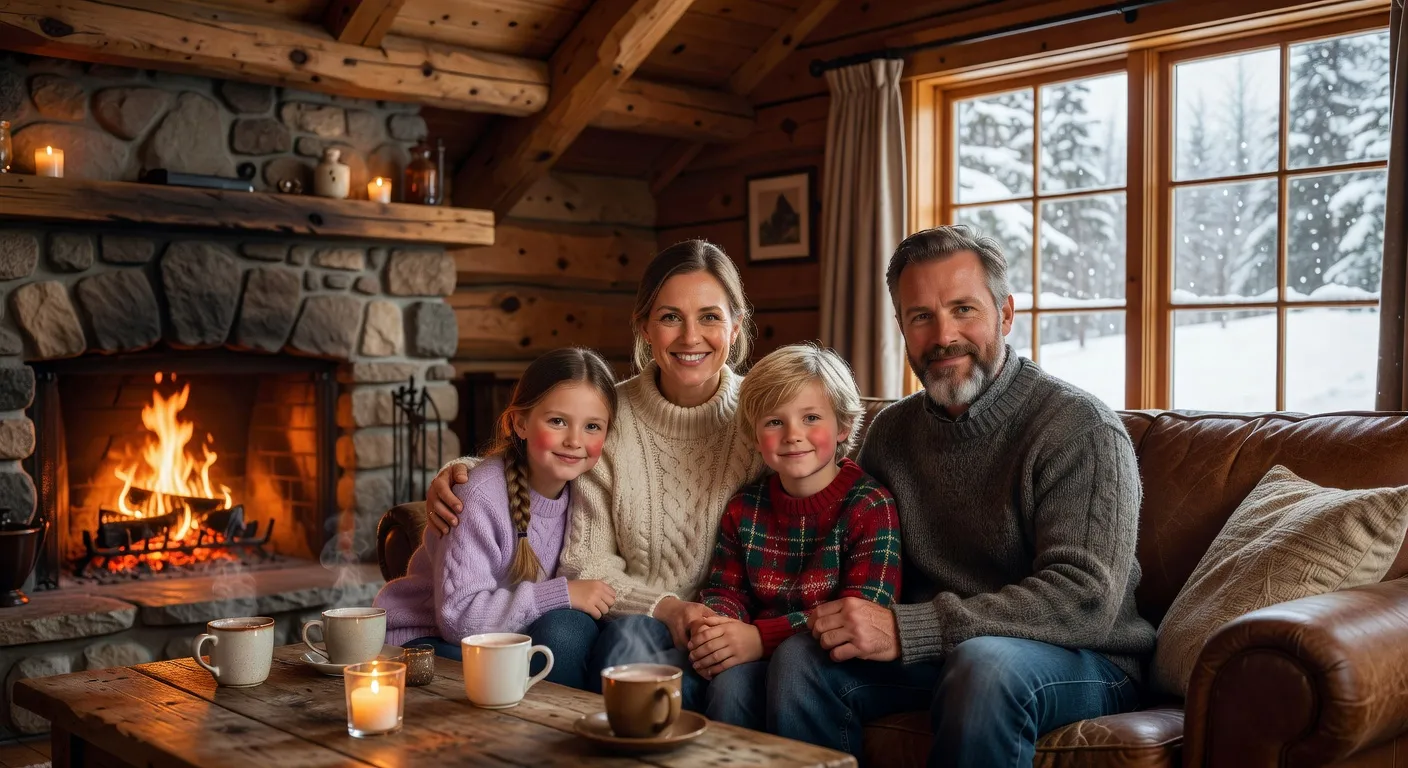
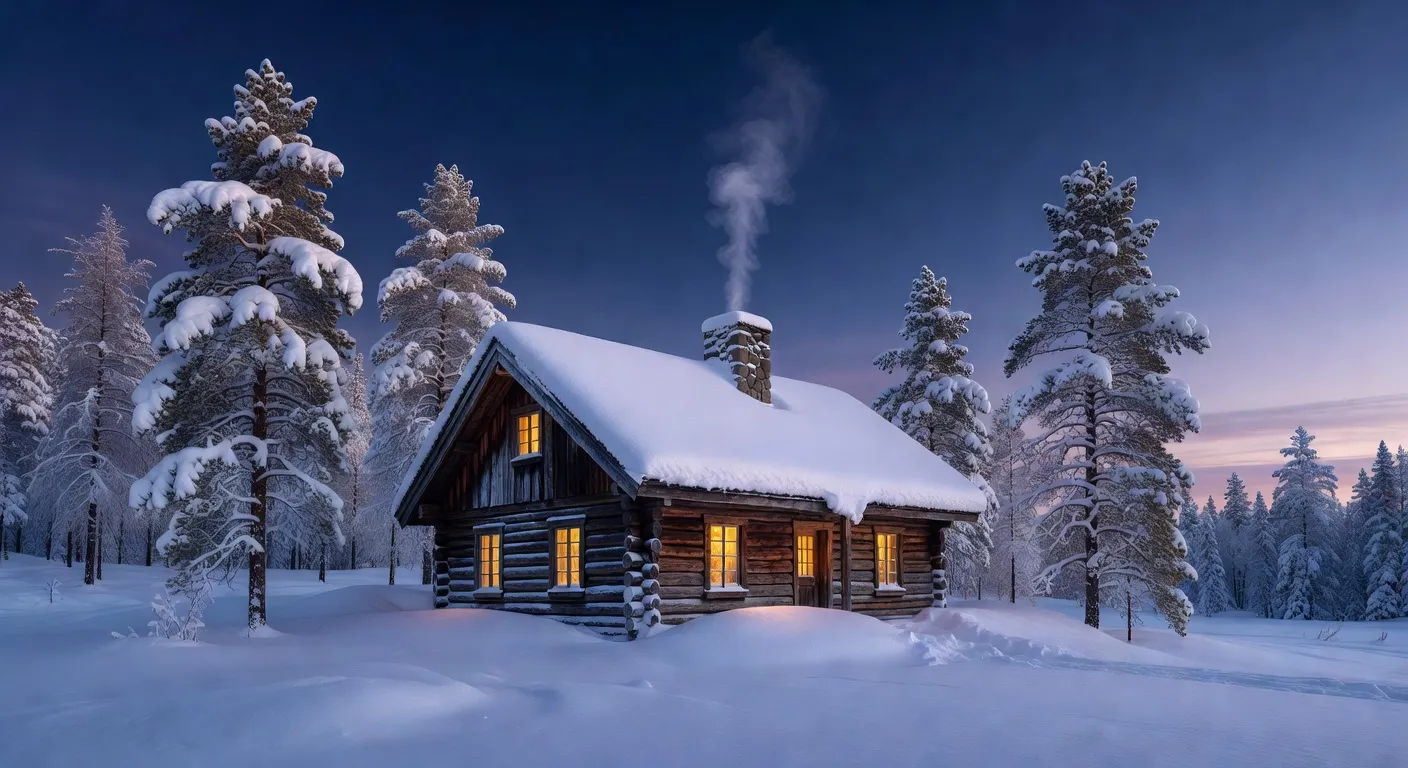
The Lavoie cottage sits on the shore of a frozen lake, an hour from Sainte-Adèle, on a road ploughed twice a week. Panoramic view over the snowy forest, central stone fireplace, triple double glazing, pellet stove as backup. Caroline opens the door with a tired smile: "We just finished school, the kids went out with their snowshoes. That has been our rhythm for three years now."
This interview goes back to the real questions you ask yourself before trying the experience. Without excessive romanticism and without alarmism.
How the idea was born
Catherine Bélanger: How did you come to spend the winter in a cottage?
Caroline Lavoie:It was a long maturation. During the 2020 pandemic, we spent two months in Vincent's parents' family cottage in July-August, and we realized we worked as well or better than in Montreal. The quiet, the light, nature 5 metres from the window — it transformed our concentration and our mood.
The following winter we tried two weeks in January, just to see. Émile and Florence were 6 and 4. It was a revelation for the children: pristine snow, animal tracks, cross-country skiing right from the cottage, the fireplace in the evening. When we got back to Montreal, they asked us for months to return to our "real home".
The next year we stretched it to a month, then two. Since 2022, we stay a full 4 months, from early December to late March.
The cottage: chosen or inherited?
Catherine Bélanger: Do you own the cottage?
Vincent Lavoie:Not exactly. It was originally my parents' family cottage — a small three-season place built in the 1980s. When we decided to live there in winter, we bought it from my parents in 2022 and invested $90,000 in four-season upgrade work: doubling the wall insulation (from R-12 to R-30), exterior roof insulation up to R-50, replacement windows in triple-glazed high solar-gain glass, full air sealing, installation of a central pellet stove and zoned electric baseboard system.
Insulating the floor slab was the most complex part — we had to jack up the whole existing structure. But it was indispensable: with an uninsulated slab, the floor stays freezing in January and the kids catch cold playing on the ground.
Daily life in a cottage winter
Catherine Bélanger: Really, what does a typical day look like?
Caroline Lavoie:We get up around 6:45. Vincent lights the fireplace on his way up, carrying two or three logs from the basement, I make coffee, we glance at the outdoor thermometer — it can be -8°C or -32°C, you get used to everything. Family breakfast with a view over the lake.
From 8 to 12, school starts for the children. We set up a large table in an alcove with two separate workstations. Vincent works from the other side of the living room. I translate from my bedroom-turned-office in the morning, and I supervise school in the afternoon. Internet via Starlink satellite, 100 Mbps, it is plenty for two simultaneous video calls.
In the afternoon, we alternate: snowshoe outings, cross-country skiing from the cottage, skating on the lake when the ice is good (always check the thickness), ice fishing on weekends. Around 5 p.m. the sun goes down. Fireplace, book, cooking. Dinner together. Kids' reading by the fire. Early bedtime.
The rhythm is slower, more seasonal. We sleep better, eat less junk food, read more. That is what we were looking for.
Distance schooling: how does it work?
Catherine Bélanger: The big question: the children's schooling. How does it work concretely?
Caroline Lavoie:We chose the distance learning offered by the school service centre of our Montreal neighbourhood. It is official, free, and follows the Quebec curriculum. The children receive workbooks and materials by mail before we leave. Teachers give weekly video sessions, grade assignments remotely, and remain reachable by email and phone.
Concretely, it works out to about 4 hours of schoolwork per child per day, 5 days a week. Shorter than a traditional school day (because you remove transitions, travel and hallway chatter), and denser too. Academic progress is at least as good as in a classic school — Émile even caught up a math gap this year.
The challenge is not academics. It is socialization. For that, we enrolled the children in the cross-country ski club of the nearby village (about thirty kids), in the Sunday skating class at the Sainte-Adèle arena, and we organize weekends in Montreal every three weeks so they see their friends. Without those links, it would get heavy.
Remote work: is it viable?
Catherine Bélanger: Vincent, you work in IT. Is remote work from a cottage in winter really as simple as people say?
Vincent Lavoie:Today, yes. Five years ago it would have been a nightmare. But Starlink changed everything for Quebec's remote regions: we get symmetric 80 to 200 Mbps with latency perfectly usable for video calls, screen sharing and remote development.
The only real challenge is redundancy. It happened to me in January 2024: I lost Starlink for 8 hours because of a solar storm. Luckily we have Vidéotron 5G as backup — slower, but it gets you through a workday. Any serious remote worker in a cottage needs two distinct internet providers.
For electricity, we have a pellet stove that runs on battery during outages, plus a gasoline generator for long outages. Hydro-Québec cuts power on average 6 to 12 hours per winter in our area — you have to plan for it.
The real budget of a cottage winter
Catherine Bélanger: What are we talking about, precisely?
Vincent Lavoie:For our cottage, which we now own, the marginal cost of a full winter is about $4,800: $1,200 electricity, $800 wood and pellets, $350 Starlink + 5G, $200 propane (for the generator and the winter BBQ), $600 snow removal (twice a week over 18 weeks), $300 insurance pro-rata, $800 recurring small expenses. Plus groceries we would have paid in Montreal anyway.
If you include opportunity cost (annual municipal taxes, amortization of the renovation work, upkeep), the real cost rises to about $9,000 for 4 months. That is $2,250 per month for a 1,500 sq ft cottage with lake and forest — cheaper than our Montreal rent.
For someone renting a four-season cottage for the full season, expect $1,800 to $4,500 per month depending on region and standard. It is an investment, but it is an experience that transforms a family.
The real difficulties
Catherine Bélanger: Let's be honest: what is hard?
Caroline Lavoie:Isolation. Not for Vincent and me — we expected it and even enjoy it. But for the children, especially Florence, who is very social. Three months without her best friends is long. That is why we go back to Montreal every three weeks.
Medical emergencies: it is 45 minutes to an ER if needed. We lived through an ear infection with Émile at 11 p.m. in January 2023 and it was stressful. We have been much more careful about preventive medical visits since.
And then resupplying. When it is -28°C with a storm, the 25-minute grocery run becomes a project. You learn to plan better, to freeze a lot, and never to run out of coffee. The culture of "I'll stop by the store after work" disappears.
Quick questions — true or false
Catherine Bélanger: A few misconceptions to run through. True or false, in two sentences.
Caroline Lavoie:"Kids fall behind at school." → False. Official distance learning follows the Quebec curriculum. Émile and Florence are at or above the level of their classmates who stayed in Montreal.
"You get bored after a month." → False. Honestly, we never had the time. Reading, nature outings, cooking, board games, craft projects. The rhythm imposed by winter naturally fills the days.
"A cottage in winter costs a fortune to heat." → True but nuanced. Poorly insulated, yes. Well insulated, it is very reasonable — we spend less on total energy than in Montreal, proportionally.
"You can't live there without a 4x4." → False. Vincent has a sedan with four Nokian Hakkapeliitta winter tires. He gets up to the cottage without trouble 95% of the time. For the 5% storm days, we wait it out.
"You end up depressed in February." → False. It is exactly the opposite. Contact with the snow, the winter light (very beautiful in Quebec), snowshoe outings — that is what protects us from the winter blues we used to get in Montreal.
"You need a fortune to buy a cottage." → False, but it depends. A three-season cabin 80 km from Montreal can still be found for $250,000 in 2026. With $70,000 to $100,000 of work, you get a credible four-season cottage. To rent a full season, expect $8,000 to $18,000.
Conclusion — 3 things to remember
Vincent Lavoie:1. It is a couple project, not an individual whim. If one of you is not convinced, it will not work. Talk it through in depth before committing.
2. Invest in insulation and connectivity above all. A well-insulated cottage with two internet providers is viable without drama. The rest is learned by doing.
3. Preserve the children's social ties. Local activities (ski club, hockey, rural theatre), regular returns to the city, video calls with their friends. Non-negotiable.
For those who would like to test it without the full commitment, several cottages rent by the full season in Quebec. See the Domaine du Lac Marsan in the Laurentians or our guide to lakefront chalets in Quebec for long-stay options. To properly prepare a cottage for the winter season from a construction and materials standpoint, also read our interview with architect Marc Tremblay.
For families interested in the broader movement of life in nature and ecotourism, the webzine Very Green Trip publishes many testimonials from couples and families who made the leap.
For a complete perspective on Quebec across four seasons — wildlife, weather, activities and eco-responsibility — read our interview with Isabelle Fortier, a nature guide on the four-season chalet in Quebec.