
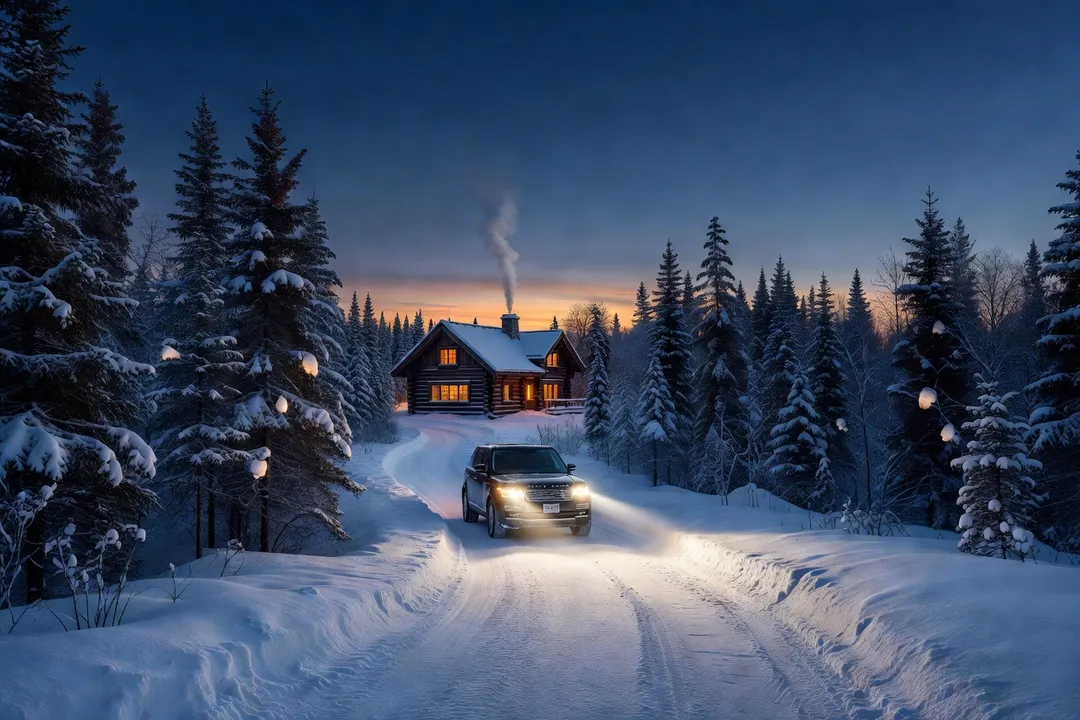
One Friday in December, a family leaves Montréal late in the afternoon for a chalet in the Laurentians. The highway is clear, and so is the regional road. Then comes the last kilometre: a gravel lane covered in fresh snow, a slope, two frozen ruts, and not a single bar of cell service left on the phone. Night fell long ago.
Reaching a chalet in winter is nothing like an urban drive. You quickly leave the well-maintained main roads for secondary roads, then for a private lane that nobody plows every day. The car has to be ready before you leave, because it will be too late to think about it once you are there. This guide brings together the checks, the gear and the habits that let you arrive without nasty surprises.
Why the Road to a Chalet Is Not Like Other Roads
A trip to a chalet almost always involves three types of road. First the highway or main road, which is maintained as a priority. Then a secondary road, where plowing is less frequent and the surface stays slippery longer. Finally the access lane to the chalet, often private, sometimes not maintained by the municipality, with a slope, bends and a parking area that may not have been cleared since the last visit.
Several constraints add up. The wooded areas of the Laurentians, the Mauricie or Charlevoix include zones without cell coverage, which complicates calling for help or checking a live map. Night falls early in December and January, and arriving after dark on an unfamiliar lane doubles the difficulty. Finally, the cold shrinks the margin for error in the mechanics: a tired battery, a poorly mixed fluid or an underinflated tire go unnoticed in the city and show up all at once 30 km from the nearest village.
If you hesitate to get behind the wheel for this kind of trip, note that there are also options without a vehicle: our guide to car-free chalets from Montréal presents the public transport options. For those who drive, preparation starts several days before the stay.
Winter Tires, the First Check Before Leaving
Tires are the only point of contact between the car and the road. In Quebec, according to Québec.ca, winter tires are mandatory from December 1 to March 15 for vehicles registered in Quebec, including those offered for rent. The tire must show the official pictogram or be fitted with studs. A fine of $200 to $300 applies to drivers who do not comply. Vehicles registered outside Quebec are not covered by this rule. Studded tires are permitted from October 15 to May 1 on passenger vehicles.
These dates are a legal minimum, not a safety guarantee. For a chalet, a few more checks are worth the detour:
- Wear: a worn tread clears slush poorly and grips ice badly. A winter tire at the end of its life is still legal, but it no longer offers the expected grip.
- Pressure: cold lowers tire pressure. Check it cold, before driving, against the value on the manufacturer’s label, often located in the driver’s door frame.
- General condition: look for cuts, bulges on the sidewalls and objects stuck in the tread.
- Four identical tires: winter tires go on all four wheels, not just the drive axle.
Before a trip to the Laurentians, a tire shop or a garage can check your tires and the car’s mechanical condition. It is better to book an appointment a few days before departure: shops are in high demand as December 1 approaches.
Other Mechanical Checks
Tires are not everything. A short inspection of the car, ideally done at a shop the week before the stay, avoids most winter breakdowns.
Brakes. A grinding noise, a spongy pedal or a vehicle that pulls to one side when braking deserves a check before you head down a snowy slope. On a chalet lane, you go downhill and brake more than you expect.
Battery. Cold puts heavy demands on a battery, and one that still starts without trouble at 5 °C can refuse to on Sunday morning, at the chalet, in extreme cold. If the battery is old or starting becomes sluggish, have it tested. A shop test is generally quick.
Wipers and washer fluid. Worn blades leave streaks and reduce visibility exactly when you need it most. Fill the washer reservoir with a winter fluid designed not to freeze at the expected temperatures. Summer washer fluid freezes in the lines and leaves the windshield blind behind a truck throwing up slush.
Heater and defroster. Test them before leaving, not at the first snowfall. A defroster that struggles to clear the windshield is a defect to fix in the city.
Engine oil and coolant. Check the levels and the date of the last oil change. The coolant must be suited to Quebec’s cold temperatures; the shop can check its concentration.
Lighting. Headlights, taillights, turn signals and brake lights must all work. On a forest road at night, they are also your signal to others.
What to Keep in the Trunk
Onboard gear is light, inexpensive and rarely used. That is exactly why it gets forgotten, until the day it is missing. For a trip to a chalet, especially in a remote area, it is worth keeping in the car:
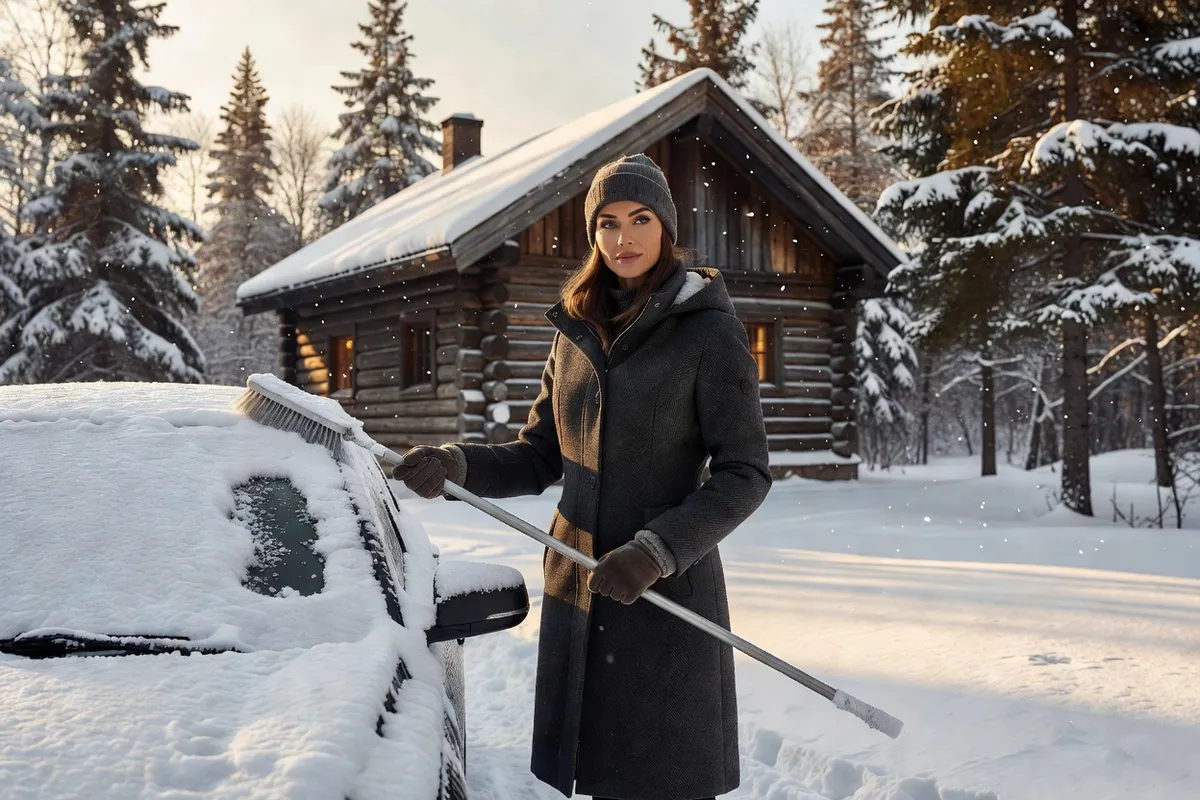
- a snow brush and an ice scraper;
- a small folding shovel to free a wheel or the back of the vehicle;
- a flashlight (with fresh batteries) or a headlamp;
- jumper cables in good condition;
- a warm blanket or a sleeping bag;
- a first aid kit;
- water and non-perishable snacks, especially for remote areas;
- a fully charged phone and its charging cable, or a power bank;
- spare gloves and a toque, and warm boots within reach rather than in the suitcase at the bottom of the trunk.
Think about how the trunk is organized. Anything that could help in an emergency must be reachable without unloading all the luggage onto the snow. On a chalet lane, the small shovel, the blanket and the flashlight are better placed near the rear door than buried under the weekend’s groceries.
Clearing the Whole Vehicle of Snow
Many drivers clear the windshield and leave. That is not enough. Before leaving the driveway, clear:
- the windshield, the rear window and all the side windows;
- the mirrors;
- the headlights and taillights, often hidden by snow and ice;
- the license plate;
- the roof, the hood and the trunk.
The roof is the spot most often forgotten. Yet snow that builds up there can slide onto the windshield at the first braking and completely block the driver’s view. It can also break loose at highway speed and hit the vehicle behind.
On the regulatory side, Québec.ca states that a fine of $60 to $100 may be issued if the vehicle is covered in snow or ice, and that a fine of $100 to $200 applies if snow or ice reduces visibility. The driver must then clean or clear the windows and windshield. The same site recommends using the snow brush and ice scraper before hitting the road.
A few practical habits: start the engine and the defroster before clearing, so the ice softens while you work. Use a brush rather than the scraper on the paint. Never pour hot water on a frozen windshield, as thermal shock can crack it.
The same applies when you leave the chalet, with one more difficulty: the car has spent the night outside and may be under a thick layer of snow. Allow an extra 15 to 20 minutes on the morning of your return.
Planning the Trip and Adapting Your Driving
Preparation does not stop at the vehicle. A winter trip to a chalet is planned like a small expedition.
Check the weather and road conditions. Québec 511 is the official road conditions information service. According to its site, you can consult a map showing winter road conditions, roadwork, events and camera images, through the website, the mobile app or by dialing 511. Check it before leaving, then a second time just before leaving the main road. Conditions can change from one hour to the next in the regions, and the site itself notes that wind and blowing snow can cause temporary differences between the posted conditions and reality.
Allow more time. On snow-covered roads, the same trip takes noticeably longer than in summer. Calculate your arrival time with a margin, and aim to arrive in daylight if possible. If your booking specifies an arrival time, let the owner know about any delay. Our guide to the best time to book a chalet also helps you pick dates when the weather is kinder.
Adapt your speed. Québec.ca asks drivers to adjust their speed to the weather and road conditions, keep a safe distance and stay alert. In practice:
- increase the distance to the vehicle ahead noticeably;
- avoid sudden acceleration and hard braking;
- brake early and gently, looking far ahead;
- approach hills with steady momentum rather than accelerating halfway up;
- be extra careful on bridges and in shaded areas, where ice lingers.
Postpone if necessary. Québec.ca urges people to postpone non-essential trips when conditions are very poor. A chalet stay is meant to be relaxing: arriving the next day beats arriving at the hospital or in a ditch. A good cancellation or date-change policy in the rental contract helps you make that decision without pressure.
Download before leaving. Because the network can drop out, download the offline map of the chalet area and save the address, the directions and the owner’s number somewhere other than just your phone, for example on paper. Let someone know your expected arrival time.
Questions to Ask the Owner Before Leaving
The owner knows the lane, the slope and the plowing habits. A few questions sent a few days before the stay avoid many surprises:
- Is the access road plowed all the way to the chalet? And by whom? Some private roads are plowed under a seasonal contract, others only on request.
- Is a four-wheel-drive vehicle necessary? Or are good winter tires enough for the last stretch?
- Where should I park? Is the parking area cleared, sloped, shared with other chalets? Is there room to turn around?
- Is there cell service? If not, is there a landline or a spot where the signal returns?
- What arrival time is recommended? Arriving in daylight changes everything.
- Is the chalet already heated on arrival? A building left cold takes time to warm up, as our article on heating a chalet in winter explains.
A serious owner is happy to answer these questions. For owners reading this guide, winterizing the chalet includes clearing the access and the parking area before renters arrive.
Electric Vehicles, Fuel and Block Heaters
Electric vehicles. In extreme cold, an electric vehicle’s range drops, notably because the cabin and the battery have to be heated. For a remote chalet, plan a generous range margin rather than counting on the last charging stations. Locate charging stations along the route and near the chalet before leaving, and ask the owner whether charging on site is possible. Preheating the vehicle while it is plugged in before leaving spares the battery. A charge that gets complicated in extreme cold is a scenario to anticipate, not to discover.
Combustion engines. Fill up before entering the last kilometres, not at the last station in the village. In winter, a half-full tank is a tank to fill: if you get stuck, the fuel also keeps you warm. If your vehicle has a block heater, plug it in according to the manufacturer’s instructions; first check with the owner that an outdoor outlet is accessible at the chalet.
Cabin heating. Keep the defroster clean and working, but do not leave the engine running needlessly in an enclosed space, such as an attached garage.
If the Vehicle Gets Stuck
A vehicle can bog down in a snowdrift, slide into a ditch or break down on a lane nobody uses. A few simple rules:
- Stay in the vehicle. It shelters you from wind and cold, and it is more visible than a person walking in the night.
- Share your position. If you have cell service, call emergency services or a towing company; if your vehicle allows it, turn on the hazard lights. Let the owner know too.
- Clear the tailpipe. Before running the engine to warm up, check that the tailpipe is not blocked by snow. A blocked exhaust can let gases build up in the cabin, including carbon monoxide, a colourless and odourless gas. Crack a window slightly for ventilation.
- Heat intermittently. Do not leave the engine running continuously: run it in short periods to save fuel, while keeping an eye on the tailpipe.
- Stay warm and dry. Wrap yourself in the blanket, keep your hands and feet sheltered, eat and drink regularly.
- Only leave on foot if the chalet is visible and very close. In the dark and in extreme cold, moving away from the vehicle without a clear landmark is dangerous.
These guidelines are common sense and match the caution recommended in winter driving guides. They do not replace a call to emergency services in distress: in a serious situation, dial 911.
Checklist: Before Leaving, in the Trunk, on Arrival
This table sums up the steps to tick off. Print it or keep a screenshot before leaving the city.
| When | What to check or do |
|---|---|
| Before leaving (a few days ahead) | Winter tires in good condition and pressure checked; battery tested; brakes, wipers and lighting checked; winter washer fluid full; oil and coolant levels checked |
| Before leaving (departure day) | Weather and road conditions checked on Québec 511; offline map downloaded; whole vehicle cleared of snow (roof, windows, lights, plate); full tank or full charge; someone told your arrival time |
| In the trunk | Snow brush and scraper; small shovel; flashlight; jumper cables; warm blanket; first aid kit; water and snacks; charged phone, cable or power bank; spare warm clothing |
| On arrival | Park in the agreed spot, without blocking a snowplow’s path; turn off the engine and check that the tailpipe is clear; confirm arrival to the owner; note where to store the shovel and brush |
| Before the return | Clear the car completely; check the weather along the route; allow more time to clear the windows and roof |
A well-prepared trip is one that goes almost unnoticed: you arrive, unload, light the stove. It is the small checks done at home that make this possible. For first-timers, it is better to underestimate your own speed and overestimate the length of the trip than the other way around.
FAQ
Are winter tires mandatory to drive to a chalet in Quebec?
Yes, for vehicles registered in Quebec: according to Québec.ca, they are mandatory from December 1 to March 15, including for rental vehicles, and the tire must carry the official pictogram or be fitted with studs. A fine of $200 to $300 applies for non-compliance. Vehicles registered outside Quebec are not covered by this requirement, but a remote chalet is still an excellent reason to equip yourself anyway.
Do I really need to clear the roof of the car before leaving?
Yes. Québec.ca states that a fine of $60 to $100 may be issued if the vehicle is covered in snow or ice, and $100 to $200 if the snow or ice reduces visibility. Beyond the fine, snow on the roof can slide onto the windshield under braking or break loose and hit the vehicle behind you. A snow brush and an ice scraper take care of it in a few minutes.
What should I keep in the car for a winter chalet stay?
The useful minimum includes a snow brush, an ice scraper, a small shovel, a flashlight, jumper cables, a warm blanket, a first aid kit, water and snacks, and a charged phone with its cable. For a remote area, add spare warm clothing and dry gloves. This kit takes little space and can make the difference if you have to wait for a tow truck.
What should I do if the car gets stuck in the snow near the chalet?
Stay warm inside the vehicle, stay calm and share your location if the network allows it. Before running the engine to heat the cabin, make sure the tailpipe is not blocked by snow, because exhaust gases, including carbon monoxide, could build up inside the car. Do not set off on foot in the dark in extreme cold without knowing where you are going: a vehicle is easier to spot than a walker.
What questions should I ask the chalet owner before leaving?
Ask whether the access road is plowed all the way to the chalet or only to a certain point, whether a four-wheel-drive vehicle or good winter tires are recommended, and where to park. Also ask whether there is cell service, how steep the last stretch is and what time of day is best for arriving. The answers determine the gear to bring and your departure time.