
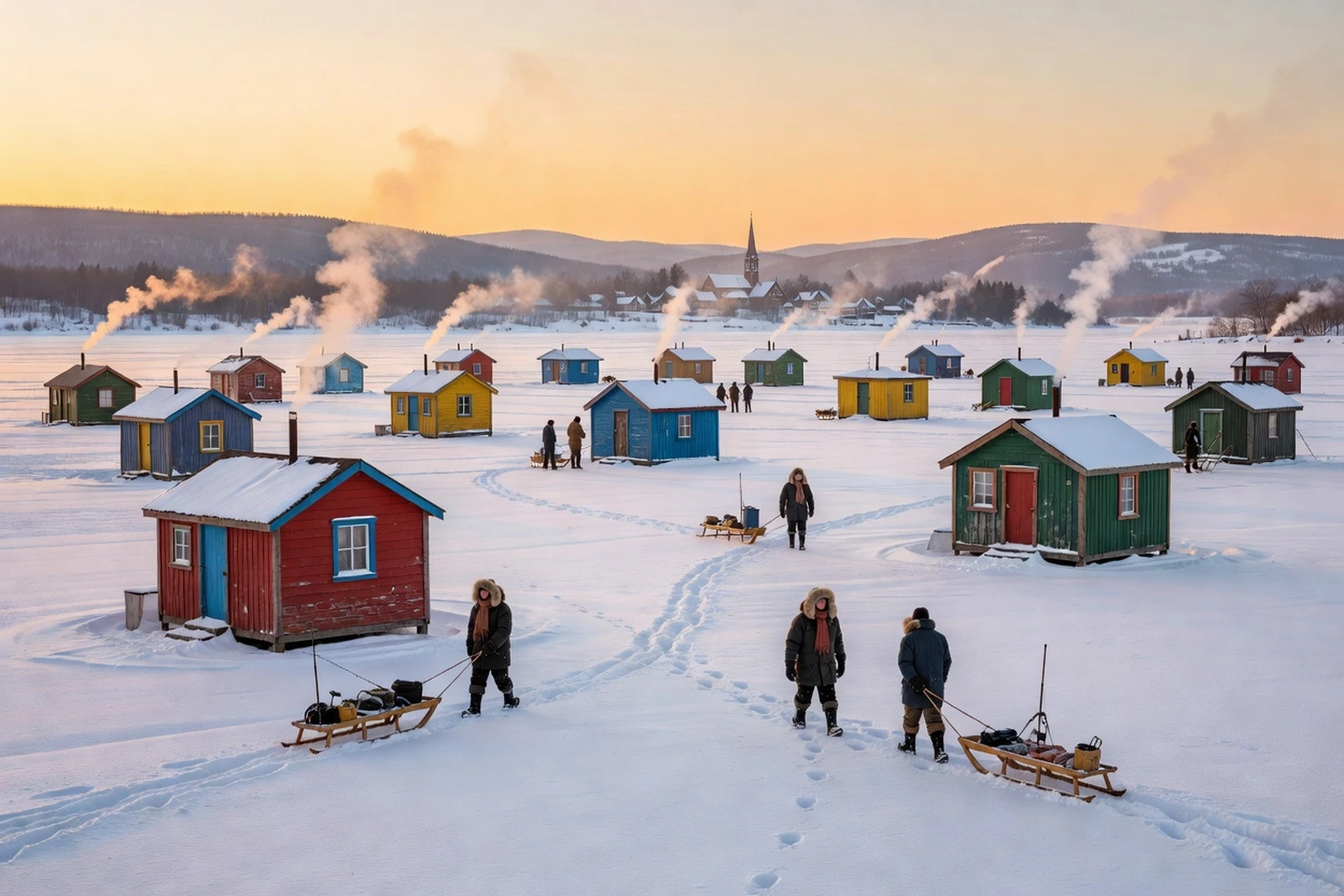
Ice fishing in Quebec runs mostly from January to mid-March, from a heated hut set on the ice, usually with a sport fishing licence, and it works very well from a cottage rented nearby. As soon as the ice holds, hundreds of small colourful huts appear on the province’s lakes and rivers, smoke rises from the wood stoves and lines drop into freshly drilled holes. Here is how to plan the trip, from the real season to the licence rules, including the two big Quebec hotspots: Sainte-Anne-de-la-Pérade and the Saguenay fjord.
Why ice fishing pairs so well with a cottage
Ice fishing is nearly motionless and cold, but not uncomfortable if the setup is right. A heated hut is your base for the day; the rented cottage takes over for the night, the meals and the evenings. In between there is no timetable and no long drive: a walk across the snow, a thermos of coffee and an angler’s patience.
The format suits very different groups:
- beginners can rent everything on site, hut and gear included, without buying anything;
- families get a winter activity that depends on no ski resort and no lift pass;
- experienced anglers reach species and waters they do not fish the same way in summer.
It also gives short winter days a simple rhythm: fishing in the morning, a walk or snowshoeing in the afternoon, back to the cottage to cook the catch. It fits nicely into January or February, once the holidays are over and spring still feels far away.
A short season set by the ice
There is no single opening date for ice fishing in Quebec: the ice decides. Bonjour Québec places the season from January to mid-March, as long as conditions allow; in Saguenay–Lac-Saint-Jean, the regional tourism office has it start around mid-January and end in early March. A mild winter can delay hut installation, and a late-season thaw can cut the season short.
On the regulatory side, the Quebec government’s winter rule is this: from December 20 to March 31, you may use up to five lines on a water body, whether or not it is covered with ice. Opening dates, catch limits and exceptions vary from one water body to another within the same fishing zone, so the official advice is to check whether your lake or river has a specific exception before drilling. To pick the right weekend, our guide to the best time to book a Quebec chalet by weather and season covers January and February demand.
In practice, the ideal weekend falls between mid-January and mid-February: the ice is generally established in southern Quebec and the hut villages are open. Book the hut at the same time as the cottage, especially for February weekends, which are often the busiest.
Ice safety is not negotiable
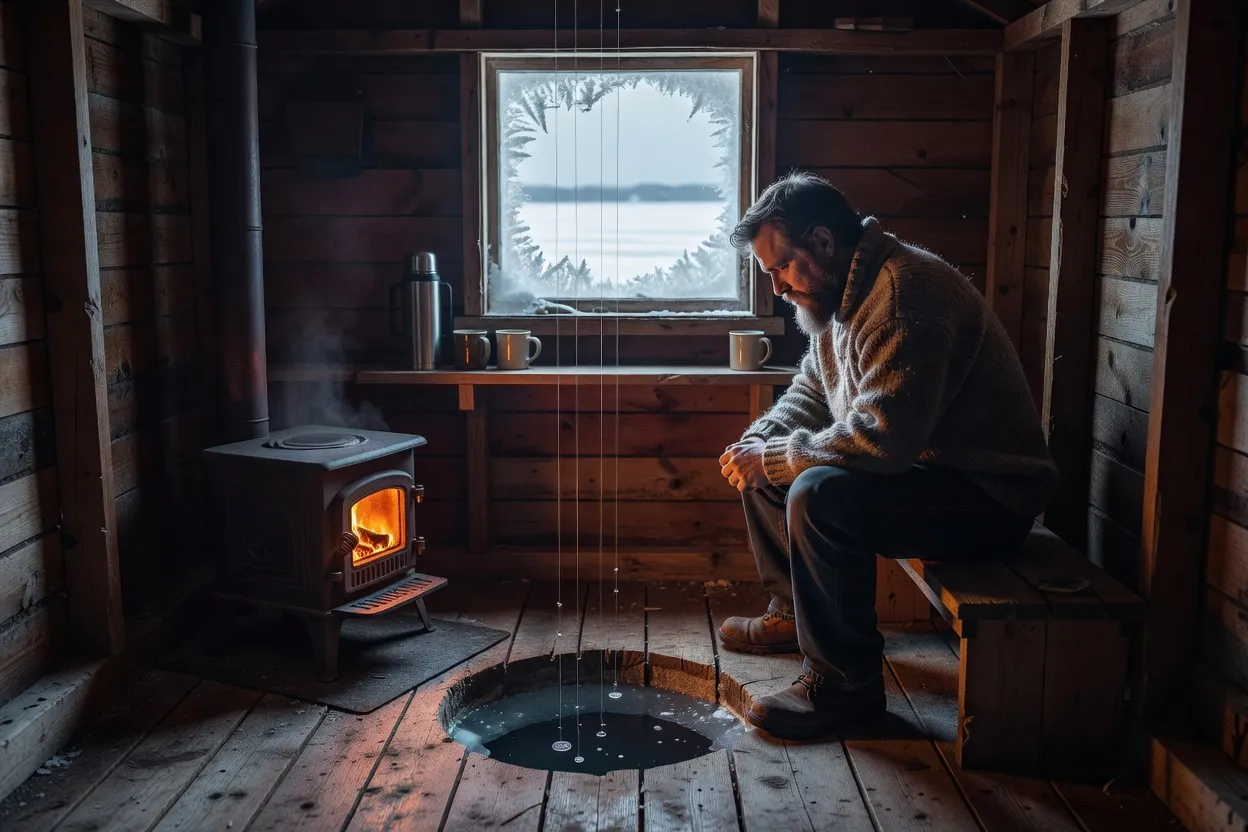
No catch is worth a fall into freezing water. The Canadian Red Cross gives simple benchmarks: ice must be at least 15 centimetres thick to walk or skate on, and 20 centimetres for a group. Colour tells you something before you even measure:
- clear blue ice, formed in calm weather, is the strongest;
- white ice, which has melted and refrozen several times, is about half as strong as blue ice;
- grey or softened ice is the weakest: avoid it under all circumstances.
The previous week’s weather matters as much as today’s. According to the Red Cross, a sudden drop in temperature does not mean the ice is thick: alternating freezing and thawing can force the ice to expand and contract, creating pressure ridges. On a body of water, the organisation also recommends wearing a personal flotation device, bringing a towline or weighted rope, wearing ice picks (small pointed handles that let you grip the ice if you fall in) and not going out alone.
The easiest way to tick these boxes is to use a fishing centre or a hut village: the operator knows the water body, maintains the access routes and can tell you about ice conditions. Saguenay–Lac-Saint-Jean tourism stresses the same point: for a successful trip, it is essential to deal with a certified company.
Sainte-Anne-de-la-Pérade, world capital of tomcod fishing
You cannot talk about ice fishing without stopping in Mauricie. Since 1938, Sainte-Anne-de-la-Pérade has set itself up on the ice of the Sainte-Anne River every winter: the municipality spoke of an 88th year for the 2025-2026 season. From December 26 to mid-February, more than 400 huts go up and welcome nearly 100,000 anglers, according to the municipality. The sight is striking at dusk, when lights glow in the windows and stove smoke rises in front of the village church.
The catch is Atlantic tomcod, a small fish averaging 15 to 30 centimetres that locals call the “petit poisson des chenaux.” Zone 27 regulations frame the event: in the stretch between the Route 138 bridge and the Autoroute 40 bridge, fishing is allowed from December 26 to March 31, with up to ten lines per angler, double the usual winter rule, and dead shrimp as the only permitted bait fish. Good news for visitors: the Quebec government exempts from the licence anyone fishing smelt and Atlantic tomcod in the St. Lawrence River and its tributaries downstream of the Laviolette Bridge in Trois-Rivières.
In 2025-2026, the fishing season ran from December 26 to February 17, with a festival animating the village on weekends from late January to mid-February. Dates change from year to year: confirm the current winter’s dates with the outfitters’ association before booking. For lodging in the area, our guide to chalet rentals in Mauricie covers the bases between Trois-Rivières, Shawinigan and the national park.
The Saguenay fjord and Lac Saint-Jean
The other big ice-fishing destination lies much farther north. On the Saguenay fjord, whose deep salt water holds around sixty fish species, hut villages go up every winter: according to Bonjour Québec, those in La Baie form one of the largest sites of their kind in the world. The catch is nothing like the southern lakes: smelt, redfish, Greenland halibut and Arctic cod are the fish that bite most often, says the regional tourism office. Another particularity: no fishing licence is required on the fjord, whereas one is needed on every other lake in the region.
Lac Saint-Jean offers a different setting, a true desert of ice, and classic freshwater catches: walleye, yellow perch and pike. There is no single site for fishing there: several companies rent huts and equipment, some with guides, for example guided outings from the ice village in Roberval. Lac Kénogami hosts a village of more than a hundred huts, the work of the Association des cabanes à pêche de Lac-Kénogami.
An ice-fishing trip to the Saguenay is planned like a small expedition: longer distances, a harsher winter, bookings to line up between the hut on the ice and the cottage on shore. For the land side of the trip, this guide to the Saguenay and its fjord covers the destination. And if the fish-rich lakes tempt you, our guide to private fishing cottages in Quebec explains how to choose a property where you can fish the following summer.
From Village Nordik to outfitters: fishing in the city or the forest
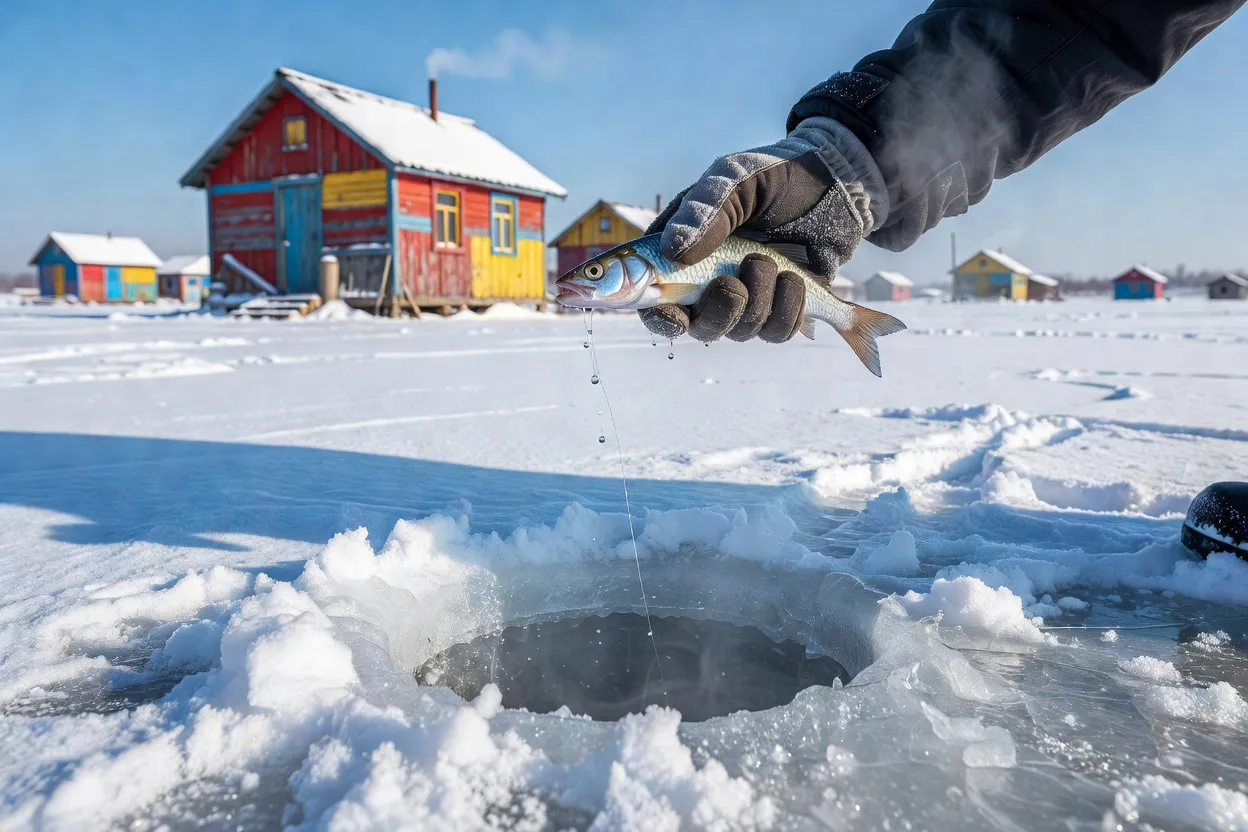
Between these two poles, the offer covers the whole spectrum. In Quebec City, Village Nordik, in the Old Port, invites the curious to try ice fishing in the middle of city life, which suits a car-free city stay. Opening dates change from year to year: confirm them with the organisation.
At the other end, outfitters offer the forest version. According to Bonjour Québec, many provide equipment and heated huts, and offer packages with lodging and meals. Some national parks and wildlife reserves also allow winter fishing, notably for brook trout. It is the formula to pick when you want quiet rather than village atmosphere. Everywhere, dates, quotas and permitted species must be checked water body by water body, because regulatory exceptions are numerous.
Licence, lines and limits: what the rules say
A sport fishing licence is mandatory, with some exceptions, and you must have it with you while fishing, along with identification. The 2026-2027 prices published by the government include taxes and the contribution to the Fondation pour la biodiversité et la faune du Québec:
| Licence category | Quebec resident | Non-resident |
|---|---|---|
| Annual (under 65) | $26.73 | $95.68 |
| Annual (65 and over) | $21.21 | Not offered |
| 7 consecutive days | Not offered | $57.67 |
| 3 consecutive days | $15.30 | $38.36 |
| 1 day | Not offered | $22.36 |
You can buy it at a point of sale or online through the Mon dossier chasse et pêche platform; the annual licence is valid from April 1 to March 31 of the following year. A useful detail for families: if you are 18 or older, your spouse or common-law partner and your children under 18 may fish under your licence, provided they are in your presence or in possession of it. Remember the two exemptions mentioned above: smelt and Atlantic tomcod downstream of the Laviolette Bridge, and the Saguenay fjord.
As for lines, the winter rule allows five lines from December 20 to March 31, raised to ten in the Sainte-Anne River sector only. Length limits then vary by species and zone: in zone 27, for example, you may keep yellow walleye from 37 to 53 centimetres inclusive and lake trout of 45 centimetres and more, while pike may be kept at any length, with local exceptions. The rules sheet for your water body, published by the government, remains the only reference that counts.
Planning your ice-fishing cottage stay
The plan comes down to three bookings, in the right order:
- The cottage, ideally within half an hour of the fishing site: January days are short and driving on snowy roads is tiring after a day outside.
- The ice hut, specifying the number of anglers and the gear you want: all-inclusive packages suit beginners, while experienced anglers will prefer the hut alone.
- A complementary activity for the non-anglers in the group.
As for luggage, the heated hut covers the essentials, but bring:
- layered clothing and insulated boots;
- mittens rather than gloves, which are easier for handling lines;
- sunglasses against snow glare;
- a cooler to bring the catch back to the cottage.
To fill the rest of the stay, our guide to winter cottage activities without skiing offers snowmobiling, snowshoeing and other outings between trips onto the ice. The fish gets cooked the same evening at the cottage, and the surplus freezes well for the trip home.
Aim for mid-January to mid-February for the best balance between established ice and availability, check the rules sheet for the water body before booking anything, go through an operator rather than improvising on the ice, and let the heated hut do the rest.
FAQ
Do you need a fishing licence to ice fish in Quebec?
In most cases, yes: a sport fishing licence is mandatory, with some exceptions, and you must carry it along with identification. For 2026-2027 it costs $26.73 for a year for a Quebec resident under 65 ($15.30 for 3 days) and from $22.36 a day for a non-resident. Two useful exceptions: no licence is required to fish smelt and Atlantic tomcod in the St. Lawrence River and its tributaries downstream of the Laviolette Bridge in Trois-Rivières, which covers the tomcod fishery at Sainte-Anne-de-la-Pérade, and the Saguenay–Lac-Saint-Jean tourism office states that no licence is needed on the Saguenay fjord, unlike the region’s other lakes.
How thick must the ice be to fish safely?
The Canadian Red Cross says ice should be at least 15 centimetres thick to walk or skate on, and 20 centimetres for a group. Colour is a first clue: clear blue ice is the strongest, white ice is roughly half as strong, and grey or softened ice should be avoided under all circumstances. The safest habit is to use a fishing centre or hut village, or to ask the operator about ice conditions before heading out.
When can you fish tomcod at Sainte-Anne-de-la-Pérade?
Zone 27 regulations allow Atlantic tomcod fishing on the Sainte-Anne River, between the Route 138 bridge and the Autoroute 40 bridge, from December 26 to March 31, with a maximum of ten lines per angler and dead shrimp as the only permitted bait fish. In practice, the municipality places the hut village between December 26 and mid-February, with the ice deciding when it closes. Confirm the exact dates for the current season with the outfitters’ association.
Can you ice fish without any equipment?
Yes, and it is the simplest way to start. Fishing centres, hut villages and outfitters rent huts set up on the ice, often heated and equipped. In Saguenay–Lac-Saint-Jean, several companies rent the hut and the gear, some with a guide. You still need layered warm clothing, insulated boots and some snacks.
What fish do you catch through the ice in Quebec?
It depends on the water body. Atlantic tomcod, a small fish averaging 15 to 30 centimetres, is the star of the Sainte-Anne River. Elsewhere, according to Bonjour Québec, you can catch walleye, pike, burbot and trout, and brook trout bite even in the cold in some parks and reserves. On the Saguenay fjord, home to around sixty species, the most frequent catches are smelt, redfish, Greenland halibut and Arctic cod. Each species has its own limits: check the rules for the specific water body.