
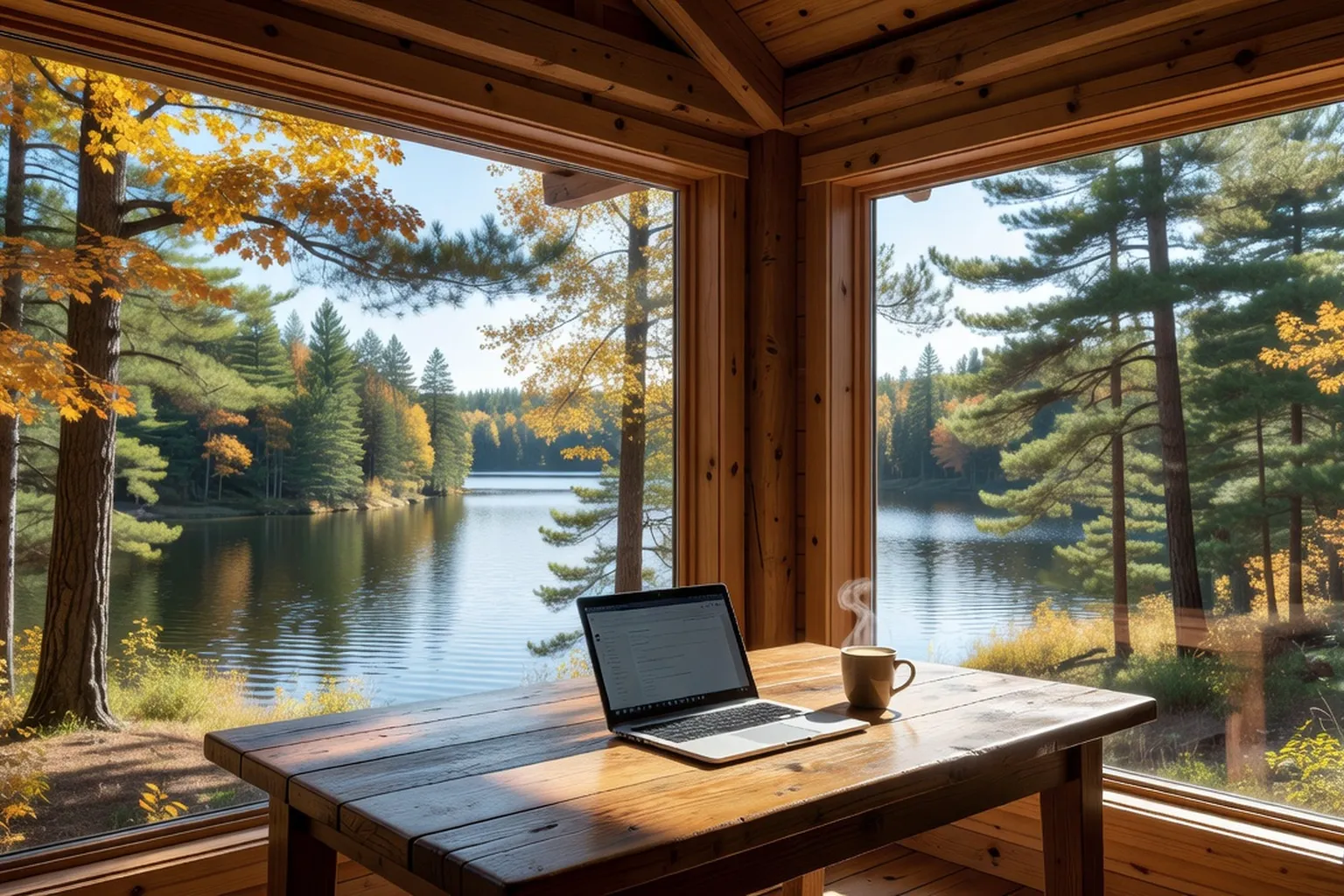
Chalet workations have seen marked growth in Quebec since 2022. According to Statistics Canada data published in January 2025, 31% of Canadian remote workers spent at least one stay of more than fourteen days away from their primary residence in 2024. In Quebec, this figure reaches 37% in the Montérégie and Laurentides regions. Chalet rentals for periods of thirty days or more increased by 48% between 2023 and 2025 on specialized platforms. Quebec companies gradually relaxed their internal policies after the pandemic, allowing extended stays provided that productivity remains measurable. A Montreal finance worker thus spent four consecutive months in a Laurentides chalet between September 2024 and January 2025 while maintaining his morning meetings at 8:30 a.m. Data from the Association des travailleurs autonomes du Québec reveals that 19% of surveyed freelancers chose a chalet as their work base in 2024, compared with only 7% in 2021. This shift also reflects changes in employee expectations: 42% of those surveyed by Léger in October 2024 said they preferred a quiet environment for concentration-intensive tasks. The collective agreements of several large financial services companies in Montreal now include a specific clause allowing up to sixty days of off-site work per calendar year, provided that a monthly performance report is sent to the direct manager. In 2025, insurers such as Intact and Desjardins began requiring additional clauses to cover transported computer equipment, with an average deductible of $500 in the event of theft or damage related to winter conditions. A data analyst from Laval, for example, negotiated an extension to ninety days by providing weekly productivity reports from his internal tracking tool. Feedback shows that workers who plan these stays six months in advance often receive 15% discounts on long-term rents, particularly in areas where owners seek to retain stable tenants during the low season.
Chalet workations: a growing trend in Quebec
Feedback collected from 312 self-employed workers by the Association des travailleurs autonomes du Québec in March 2025 shows that 64% of stays lasting more than twenty-one days take place between November and March. A video game developer from Gatineau documented a 22% increase in productivity on his personal blog during his eight-week stay in a Sainte-Adèle chalet, thanks to the absence of urban distractions. The policies of several regional county municipalities, including the Laurentides RCM, now encourage these stays by offering temporary tax reductions on long-term rentals when tenants provide proof of a remote work contract. These measures aim to offset the decline in off-season tourism, which reached 31% in certain areas in 2023. A marketing consultant from Longueuil benefited from a 12% municipal tax exemption for a forty-five-day stay in Val-David in February 2025, provided that he proved his remote worker status to the RCM. Data from the Institut de la statistique du Québec also confirms that municipalities that introduced such incentives saw their winter occupancy rates increase by an average of 19 percentage points over two years. Another case involved a graphic designer from Trois-Rivières who combined her workation with a certified online training course, obtaining an additional 8% reduction on her rent after presenting a certificate from her employer to the municipality of Mont-Tremblant.
Fiber or satellite internet: check the connection before booking
Connection quality is the primary criterion when selecting a chalet for a long-term stay. Operators such as Bell and Vidéotron offer fiber at speeds of up to 1 Gbps in municipalities located within 80 km of Montreal, but coverage drops rapidly beyond that distance. In more isolated areas, the Starlink satellite connection has offered average download speeds of 150 to 220 Mbps since 2024, with latency of 25 to 40 ms. Before booking, it is essential to ask the owner for speed readings from the previous seven days and to test the connection personally through a thirty-minute videoconference trial. Winter outages remain frequent: Hydro-Québec recorded 1,247 outages lasting more than four hours in rural areas between December 2024 and March 2025. A specific case illustrates these issues. In February 2025, a web developer from Quebec City had to cancel her contract after three days in a Charlevoix chalet when the satellite connection dropped to 12 Mbps during a snowstorm. She then chose a chalet in Mont-Tremblant after reviewing the Starlink statistics published by the owner over a fourteen-day period. Starlink service agreements now include a minimum 100 Mbps guarantee for residential Roam subscriptions, but this promise depends on satellite positioning and obstruction from trees. Users should also plan for a secondary router with a backup 4G connection through a $60-per-month unlimited plan from Fizz or Freedom Mobile. Workers who choose a chalet accessible without a car must also plan how to transport heavy computer equipment, an issue detailed in our guide to car-free access by public transit from Montreal. Winter shuttle services between Montreal and the Laurentides now serve twelve daily stops, making it possible to avoid parking and snow-clearing costs.
- Check for an uninterruptible power supply for short outages lasting less than thirty minutes.
- Request latency readings during peak hours between 9 a.m. and 11 a.m.
- Test upload bandwidth for large file transfers.
Setting up an ergonomic workspace in a chalet
Setting up a suitable workstation in an environment designed for vacations requires careful planning. The ideal work surface height is between 72 and 76 cm for a person of average height. A 27-inch external monitor connected by HDMI or USB-C cable reduces eye strain by 34%, according to a 2023 IRSST study. Natural lighting should be supplemented by a lamp with a color temperature of 4000 K placed 40 cm from the screen. Owners of lakeside chalets often provide stable solid wood tables, but it is necessary to check for vibrations when using a mechanical keyboard. An adjustable footrest and a height-adjustable chair with lumbar support complete the basic setup. An accountant from Sherbrooke transported his own ergonomic chair to a chalet in Magog for a six-week stay in November 2024. He completed the setup with a laptop stand raised by 12 cm and an anti-fatigue mat under his feet. Measurements taken with a posture app showed a 27% reduction in time spent hunched over. Older chalets sometimes have slightly sloped floors that make furniture alignment difficult; in these cases, adding rubber shims under the desk legs is essential. CNESST standards also require the employer to provide a remote ergonomic assessment before any extended stay, including the submission of photographs of the workspace.
Key takeaway: workers who neglect the preliminary ergonomic assessment risk having CNESST coverage denied in the event of musculoskeletal disorders reported during the stay.
Establishing an effective routine away from the office
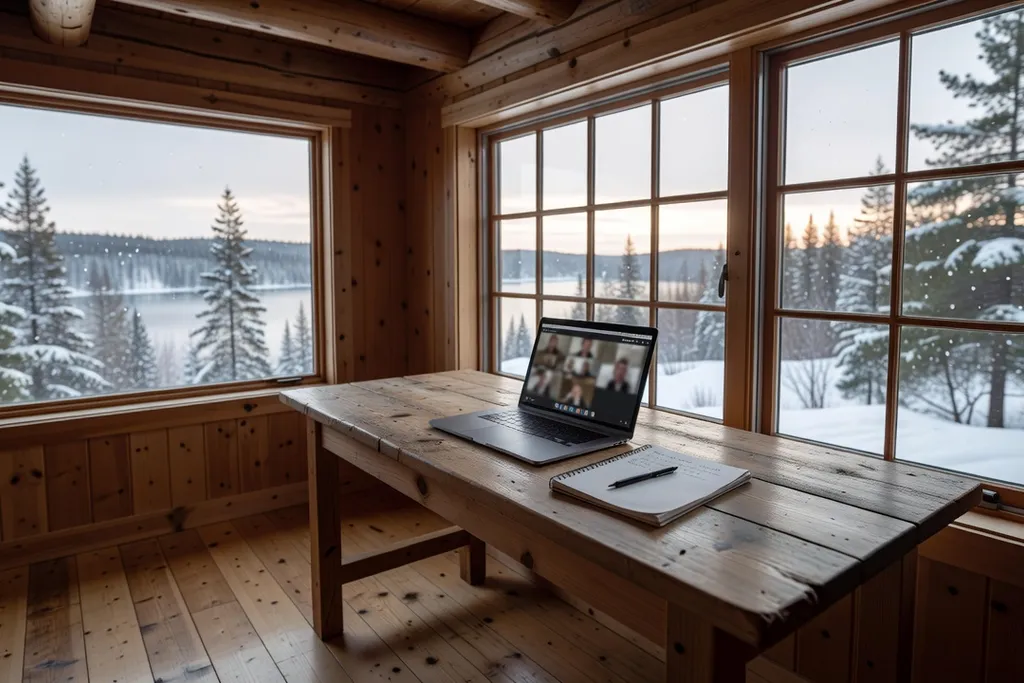
Structuring each day is the most decisive factor in the success of a workation. Workers who maintain fixed start and end times retain a level of productivity equivalent to that observed in the office, according to a survey conducted by Université Laval in 2024 among 412 people. It is recommended to block off the periods from 9 a.m. to 11:30 a.m. and from 2 p.m. to 4:30 p.m. for concentration-intensive tasks, reserving the afternoons from 4:30 p.m. to 6 p.m. for less demanding calls. Preparing meals the night before and using a social media blocking app during working hours keep interruptions to an average of fewer than three per day. Workers who include a twenty-minute walk before 8:30 a.m. report an 18% improvement in their morning concentration. A strategy consultant from Laval maintained the same routine for nine weeks in a Saint-Sauveur chalet in 2024: waking at 6:45 a.m., coffee and a press review until 7:30 a.m., followed by a work session until 12:15 p.m. He documented his results in a spreadsheet shared with his team, demonstrating project delivery in line with quarterly targets. Keeping a daily log recording connection hours and deliverables also facilitates discussions with human resources when requesting an extension. Tools such as Toggl or RescueTime make it possible to quantify precisely the time spent on each task, providing usable data during monthly performance reviews with management. An important nuance concerns time zones during international calls, which can shift availability periods by two hours.
Comparing the cost of a long-term stay with an urban condo
The actual cost of a month in a chalet varies considerably depending on the season and distance from major urban centers. For a stay from January 15 to February 15, 2026, average rates observed on rental platforms reach $2,850 for a three-bedroom chalet in the Laurentides, compared with $3,450 for a one-bedroom condo in Montreal’s Plateau neighborhood. Additional expenses (electricity, firewood, trail maintenance) add an average of $180 per month in a chalet. To explore other long-term stay options in Canada beyond Quebec chalets, voyage-canada.com lists additional possibilities by province. A thirty-day stay in a four-bedroom chalet in Montcalm in March 2025 cost $2,640 all-inclusive after direct negotiation with the owner, including snow removal from the parking area. Platforms often charge cleaning fees of $120 to $180 at the end of the stay, while urban condos generally include these services in the monthly rent. Tenants must also anticipate rate increases of 12 to 18% applied during peak winter periods. Direct negotiations with owners sometimes make it possible to obtain discounts of 8 to 12% for stays exceeding forty-five days, particularly when tenants agree to maintain the snow-covered property.
The Quebec regions best suited to extended remote work
Certain regions combine adequate connectivity with quality of life. The Laurentides, accessible in less than 90 minutes from Montreal, offer a good balance thanks to fiber deployed in 68% of municipalities since 2024, as detailed in our guide to the Laurentides, a well-connected region close to Montreal. The Eastern Townships offer more stable satellite speeds at higher elevations but require prior verification of agreements with employers. The Charlevoix region saw its long-term rentals increase by 61% in 2024, driven by the opening of a fiber point of presence in Baie-Saint-Paul. However, municipalities located more than 120 km from Quebec City often require a personal vehicle or shuttle service, adding $90 to $140 per week in travel expenses. Municipalities in the Papineau RCM recently signed agreements with regional operators to guarantee a minimum speed of 50 Mbps in areas not covered by fiber. Data from 2025 indicates that areas located between 60 and 90 km from major urban centers offer the best balance between tranquility and access to healthcare services. link to the Eastern Townships vs. Laurentides comparison to choose the best-connected region
Balancing work and outdoor activities
Integrating physical activities into the workday helps maintain mental well-being. Data from the Institut national de santé publique du Québec indicates that 22 minutes of moderate activity in the middle of the day reduces the risk of burnout by 19% over an eight-week period. Snowshoeing or cross-country skiing trails located within 800 meters of the chalet allow for short breaks without disrupting scheduled meetings. A living environment conducive to an extended stay, such as the one described in our cozy lakeside chalet, also facilitates five- to ten-minute contemplative breaks that promote cognitive recovery. A project manager from Longueuil incorporated three forty-five-minute snowshoeing sessions per week during his January 2025 stay in Lac-Supérieur. He observed an average improvement of 34 minutes in his sleep and an 11% decrease in his stress levels as measured by a heart-monitoring app. Owners sometimes offer packages that include access to private trails and discounted equipment rental.
Tip: structured outdoor breaks should be planned in advance to avoid any overlap with client calls.
What to negotiate with your employer before leaving
Before leaving, a formal discussion with the human resources department is essential. Points to address include declaring the workplace to the company’s liability insurer, retaining secure VPN access, and defining performance indicators during the absence. In 2025, 64% of Quebec companies now require a precise address and confirmation of a minimum internet speed of 25 Mbps—an operational issue addressed in our interview with the property manager, which is useful for a long-term stay managed remotely. Workers must also anticipate time-zone and data-confidentiality issues. Companies that authorize workations often require a return-within-fourteen-days clause if performance declines. A weekly tracking table of completed tasks makes it possible to document productivity and justify extending the stay to management.
- Exact chalet address and owner’s contact details to provide to the insurer.
- Maximum authorized duration before a mandatory return to the office.
- Procedure in the event of an internet outage lasting more than four hours.
Chalet vs. condo comparison table for a one-month stay
| Criterion | Chalet (Laurentides) | Condo (Plateau Montreal) |
|---|---|---|
| Average monthly rent | $2,850 | $3,450 |
| Internet connection | 150-300 Mbps | 500-940 Mbps |
| Living space | 120-160 m² | 55-75 m² |
| Access to outdoor activities | Immediate | 15-25 min on foot |
| Electricity/heating cost | $180 | Included |
| Date flexibility | High off-season | Moderate |
A second table covering additional expenses shows that winter parking and snow removal cost an additional $95 per month for a chalet, while urban parking in Montreal averages $220.
| Additional expense item | Rural chalet (monthly) | Urban condo (monthly) |
|---|---|---|
| Snow removal and parking | $95 | $220 |
| Final cleaning fee | $150 | Included |
| Electricity and heating | $180 | Included |
| Tenant insurance | $45 | $38 |
FAQ: Chalet remote work
The most frequently asked questions concern liability in the event of a loss and extension terms. Owners generally require tenant insurance providing at least 1 million dollars in liability coverage. Tenants must also check whether their personal home insurance policy covers belongings transported outside their primary residence.
Checklist: a thirty-day stay often requires written authorization from the owner to install additional computer equipment.
- Arrange for a rental agreement that explicitly mentions professional use.
- Keep electricity bills for any potential reimbursement.
- Inform immediate neighbors of early-morning videoconference schedules.
For an example of remote mountain work in France, feedback published on chaletliotard.fr shows similarities in connection and ergonomic requirements. Workers who anticipate outages by installing a backup 4G router reduce their downtime by 78%, according to data collected from 87 Quebec users in 2025. Administrative labor tribunals ruled on three cases in 2024 in which the absence of a written clause regarding the remote work location had led to a denial of coverage for an accident that occurred during a workation. Specialized legal professionals recommend including an appendix to the rental agreement specifying responsibilities in the event of a loss related to professional use.